Datasheet4U Logo Datasheet4U.com

74HC126D - Quad Bus Buffer

Download the 74HC126D datasheet PDF. This datasheet also covers the 74HC125D variant, as both devices belong to the same quad bus buffer family and are provided as variant models within a single manufacturer datasheet.

General Description

2.

The 74HC125D,74HC126D are high speed CMOS QUAD BUS BUFFERs fabricated with silicon gate C2MOS technology.

Key Features

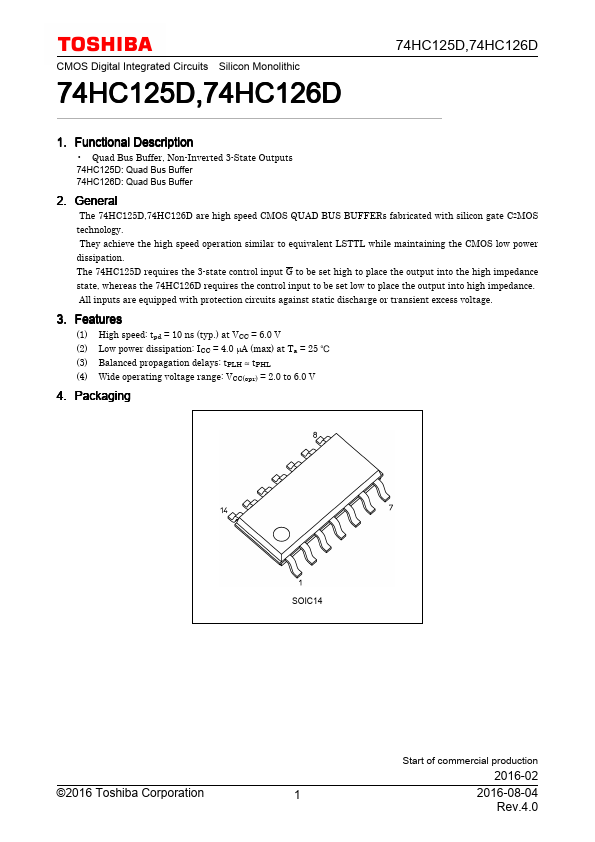
  • (1) High speed: tpd = 10 ns (typ. ) at VCC = 6.0 V (2) Low power dissipation: ICC = 4.0 µA (max) at Ta = 25  (3) Balanced propagation delays: tPLH ≈ tPHL (4) Wide operating voltage range: VCC(opr) = 2.0 to 6.0 V 4. Packaging SOIC14 ©2016 Toshiba Corporation 1 Start of commercial production 2016-02 2016-08-04 Rev.4.0 5. Pin Assignment 74HC125D 74HC125D,74HC126D 74HC126D 6. Marking 74HC125D 7. IEC Logic Symbol 74HC125D 74HC126D 74HC126D ©2016 Toshiba Corporation 2 2016-08-04 Rev.4.0 8.

📥 Download Datasheet

Note: The manufacturer provides a single datasheet file (74HC125D-Toshiba.pdf) that lists specifications for multiple related part numbers.

Full PDF Text Transcription (Reference)

The following content is an automatically extracted verbatim text from the original manufacturer datasheet and is provided for reference purposes only.

View original datasheet text
CMOS Digital Integrated Circuits Silicon Monolithic 74HC125D,74HC126D 74HC125D,74HC126D 1. Functional Description • Quad Bus Buffer, Non-Inverted 3-State Outputs 74HC125D: Quad Bus Buffer 74HC126D: Quad Bus Buffer 2. General The 74HC125D,74HC126D are high speed CMOS QUAD BUS BUFFERs fabricated with silicon gate C2MOS technology. They achieve the high speed operation similar to equivalent LSTTL while maintaining the CMOS low power dissipation. The 74HC125D requires the 3-state control input G to be set high to place the output into the high impedance state, whereas the 74HC126D requires the control input to be set low to place the output into high impedance. All inputs are equipped with protection circuits against static discharge or transient excess voltage. 3.