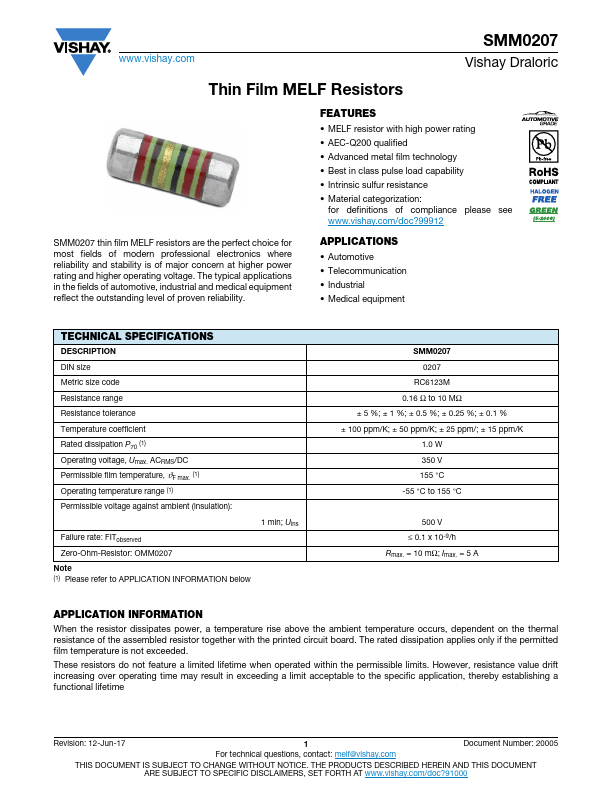
• Part: SMM0207
  • Description: Thin Film MELF Resistors
  • Manufacturer: Vishay
  • Size: 178.12 KB
Download SMM0207 Datasheet PDF
Vishay
SMM0207
SMM0207 is Thin Film MELF Resistors manufactured by Vishay.
FEATURES - MELF resistor with high power rating - AEC-Q200 qualified - Advanced metal film technology - Best in class pulse load capability - Intrinsic sulfur resistance - Material categorization: for definitions of pliance please see .vishay./doc?99912 APPLICATIONS - Automotive - Telemunication - Industrial - Medical equipment TECHNICAL SPECIFICATIONS DESCRIPTION DIN size Metric size code Resistance range Resistance tolerance Temperature coefficient Rated dissipation P70 (1) Operating voltage, Umax. ACRMS/DC Permissible film temperature, ϑF max. (1) Operating temperature range (1) Permissible voltage against ambient (insulation): Failure rate: FITobserved Zero-Ohm-Resistor: OMM0207 1 min; Uins Note (1) Please refer to APPLICATION INFORMATION below SMM0207 0207 RC6123M 0.16 Ω to 10 MΩ ± 5 %; ± 1 %; ± 0.5 %; ± 0.25 %; ± 0.1 % ± 100 ppm/K; ± 50 ppm/K; ± 25 ppm/; ± 15 ppm/K 1.0 W 350 V 155 °C -55 °C to 155 °C 500 V ≤ 0.1 x 10⁻⁹/h Rmax. = 10 mΩ; Imax. = 5 A APPLICATION INFORMATION When the resistor dissipates power, a temperature rise above the ambient temperature occurs, dependent on the thermal resistance of the assembled resistor together with the printed circuit board. The rated dissipation applies only if the permitted film temperature is not exceeded. These resistors do not feature a limited lifetime when operated within the permissible limits. However, resistance value drift increasing over operating time may result in exceeding a limit acceptable to the specific application, thereby establishing a functional lifetime Revision: 12-Jun-17 1 Document Number: 20005 For technical questions, contact: melf@vishay. THIS DOCUMENT IS SUBJECT TO CHANGE WITHOUT NOTICE. THE PRODUCTS DESCRIBED HEREIN AND THIS DOCUMENT ARE SUBJECT TO SPECIFIC DISCLAIMERS, SET FORTH AT .vishay./doc?91000 .vishay. Vishay Draloric MAXIMUM RESISTANCE CHANGE AT RATED DISSIPATION OPERATION...