Vishay AN728
The efficiency of the converter powering the NT is extremely important, even at power levels of a few milliwatts. The components of these losses include the dc and switching losses in the semiconductors, the transformer, quiescent current overhead in the control chip, current and voltage sense networks, power losses from the ripple current through the input and output capacitor ESR, resistive losses in the PCB traces, and any external control circuit operating losses.- Min Voltage : 7.2V
- Max Voltage : 9V
- Max Operating Temp : 80°C
- Min Operating Temp : -35°C
Source:
Octopart
| Part No. | AN728 |
|---|---|
| Datasheet | AN728 Download |
| Manufacturer |  Vishay |
| Description | Designing A Flyback Converter |
| Buy | Stock & Price |
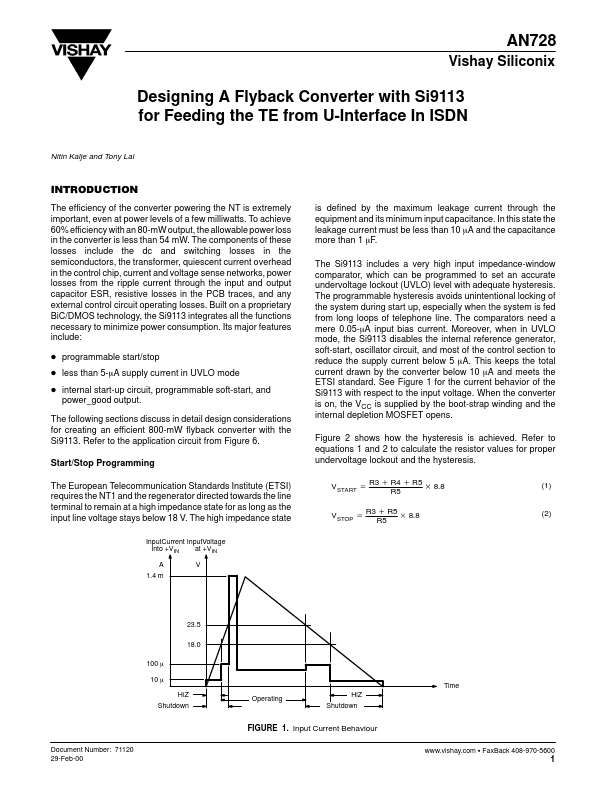
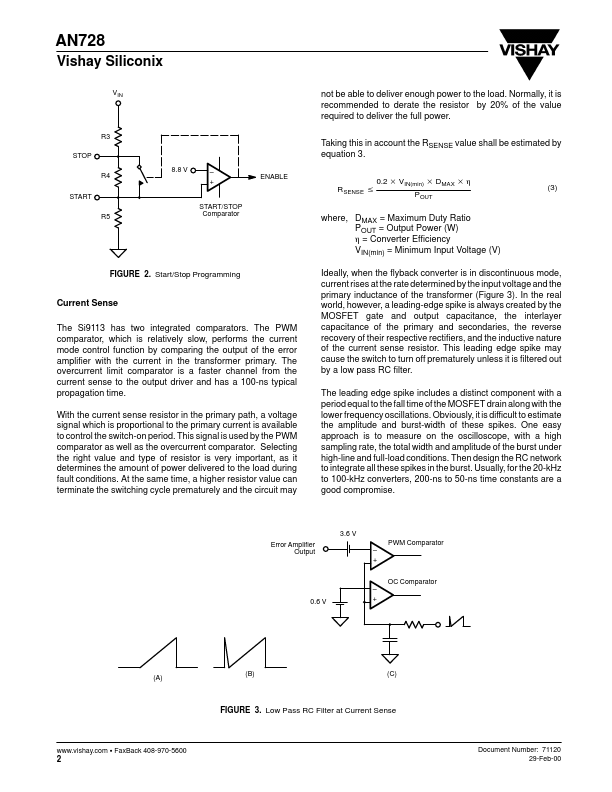
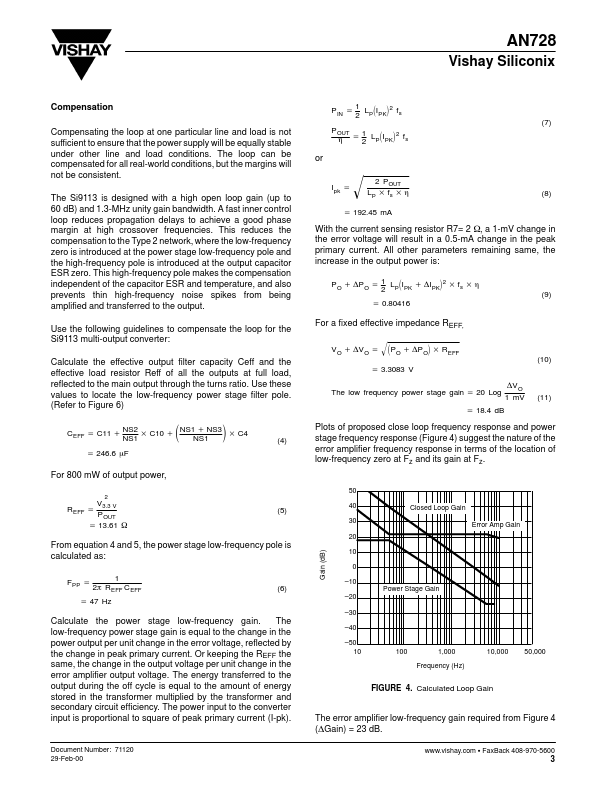
AN728 Vishay Siliconix Designing A Flyback Converter with Si9113 for Feeding the TE from U-Interface In ISDN Nitin Kalje and Tony Lai INTRODUCTION To achieve 60% efficiency with an 80-mW output, the allowable power loss in the converter is less than 54 mW. Built on a proprietary BiC/DMOS technology, the Si9113 integrates all the functions necessary to minimize power consumption. Its major features include: D programmable start/stop D less than 5-mA supply current in UVLO mode D internal start-up circuit, programmable soft-start, and power_good output. The following sections discuss in detail design considerations for creating an efficient 800-mW flyback converter with the Si9113. Refer to the application circuit from Figure 6. Start/Stop Programming The European Telecommunication Standards Institute (ETSI) requires the NT1 and the regenerator directed towards the line terminal to remain at a high impedance state for as long as the input line voltage stays below 18 V. The high impedance...