Datasheet4U Logo Datasheet4U.com

LH1522AAC - Dual 1 Form A Solid-State Relay

Download the LH1522AAC datasheet PDF. This datasheet also covers the LH1522AB variant, as both devices belong to the same dual 1 form a solid-state relay family and are provided as variant models within a single manufacturer datasheet.

General Description

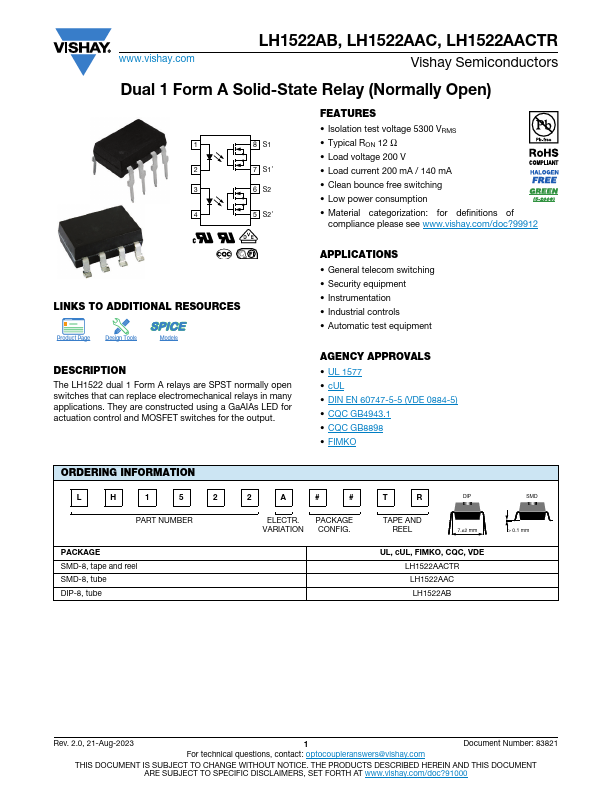
The LH1522 dual 1 Form A relays are SPST normally open switches that can replace electromechanical relays in many applications.

They are constructed using a GaAIAs LED for actuation control and MOSFET switches for the output.

General telecom switching Security equip

Key Features

  • Isolation test voltage 5300 VRMS 1 8 S1.
  • Typical RON 12 Ω.
  • Load voltage 200 V 2 7 S1'.
  • Load current 200 mA / 140 mA 3 6 S2.
  • Clean bounce free switching.
  • Low power consumption 4 5 S2'.
  • Material categorization: for definitions of compliance please see www. vishay. com/doc?99912 LINKS TO.

📥 Download Datasheet

Note: The manufacturer provides a single datasheet file (LH1522AB-Vishay.pdf) that lists specifications for multiple related part numbers.

Datasheet Details

Part number LH1522AAC
Manufacturer Vishay
File Size 238.03 KB
Description Dual 1 Form A Solid-State Relay
Datasheet download datasheet LH1522AAC Datasheet

Full PDF Text Transcription (Reference)

The following content is an automatically extracted verbatim text from the original manufacturer datasheet and is provided for reference purposes only.

View original datasheet text
www.vishay.com LH1522AB, LH1522AAC, LH1522AACTR Vishay Semiconductors Dual 1 Form A Solid-State Relay (Normally Open) FEATURES • Isolation test voltage 5300 VRMS 1 8 S1 • Typical RON 12 Ω • Load voltage 200 V 2 7 S1' • Load current 200 mA / 140 mA 3 6 S2 • Clean bounce free switching • Low power consumption 4 5 S2' • Material categorization: for definitions of compliance please see www.vishay.com/doc?99912 LINKS TO ADDITIONAL RESOURCES Product Page Design Tools Models DESCRIPTION The LH1522 dual 1 Form A relays are SPST normally open switches that can replace electromechanical relays in many applications. They are constructed using a GaAIAs LED for actuation control and MOSFET switches for the output.