Datasheet4U Logo Datasheet4U.com

SR306 - HIGH CURRENT SCHOTTKY BARRIER RECTIFIER

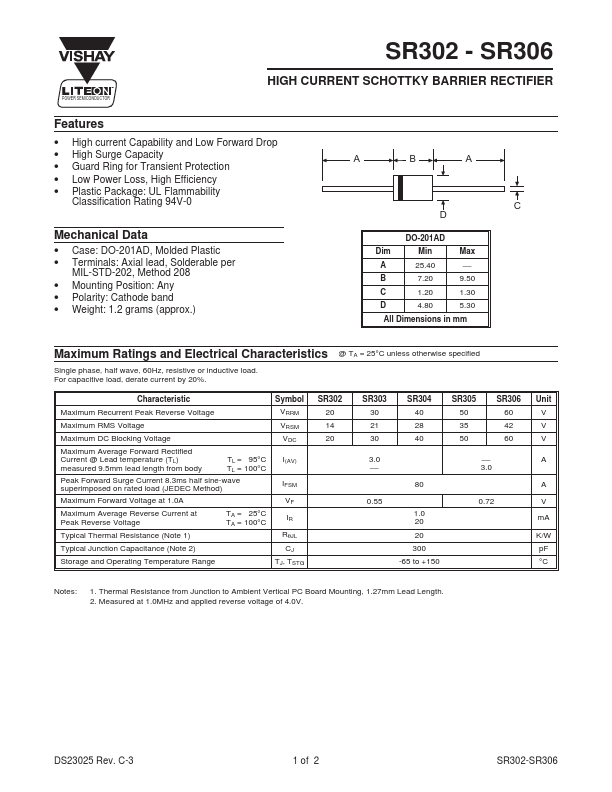
Download the SR306 datasheet PDF. This datasheet also covers the SR302 variant, as both devices belong to the same high current schottky barrier rectifier family and are provided as variant models within a single manufacturer datasheet.

Key Features

  • High current Capability and Low Forward Drop.
  • High Surge Capacity.
  • Guard Ring for Transient Protection.
  • Low Power Loss, High Efficiency.
  • Plastic Package: UL Flammability Classification Rating 94V-0 Mechanical Data.
  • Case: DO-201AD, Molded Plastic.
  • Terminals: Axial lead, Solderable per MIL-STD-202, Method 208.
  • Mounting Position: Any.
  • Polarity: Cathode band.
  • Weight: 1.2 grams (approx. ) ABA D DO-201AD Dim Mi.

📥 Download Datasheet

Note: The manufacturer provides a single datasheet file (SR302-Vishay.pdf) that lists specifications for multiple related part numbers.

Datasheet Details

Part number SR306
Manufacturer Vishay
File Size 27.09 KB
Description HIGH CURRENT SCHOTTKY BARRIER RECTIFIER
Datasheet download datasheet SR306 Datasheet

Full PDF Text Transcription (Reference)

The following content is an automatically extracted verbatim text from the original manufacturer datasheet and is provided for reference purposes only.

View original datasheet text
SR302 - SR306 POWER SEMICONDUCTOR HIGH CURRENT SCHOTTKY BARRIER RECTIFIER Features • High current Capability and Low Forward Drop • High Surge Capacity • Guard Ring for Transient Protection • Low Power Loss, High Efficiency • Plastic Package: UL Flammability Classification Rating 94V-0 Mechanical Data • Case: DO-201AD, Molded Plastic • Terminals: Axial lead, Solderable per MIL-STD-202, Method 208 • Mounting Position: Any • Polarity: Cathode band • Weight: 1.2 grams (approx.) ABA D DO-201AD Dim Min Max A 25.40  B 7.20 9.50 C 1.20 1.30 D 4.80 5.30 All Dimensions in mm C Maximum Ratings and Electrical Characteristics @ TA = 25°C unless otherwise specified Single phase, half wave, 60Hz, resistive or inductive load. For capacitive load, derate current by 20%.