Datasheet4U Logo Datasheet4U.com

SiP12107 - 3A Current-Mode Constant On-Time Synchronous Buck Regulator

General Description

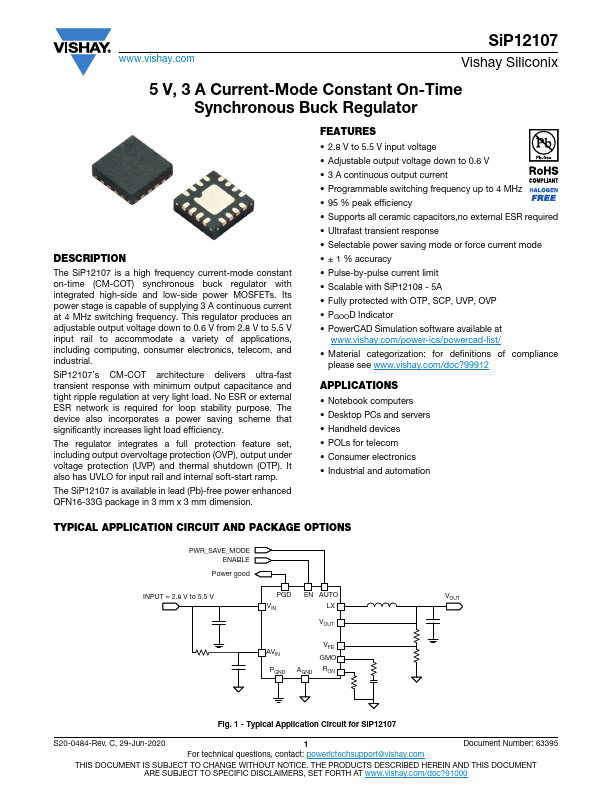
The SiP12107 is a high frequency current-mode constant on-time (CM-COT) synchronous buck regulator with integrated high-side and low-side power MOSFETs.

Its power stage is capable of supplying 3 A continuous current at 4 MHz switching frequency.

Key Features

  • 2.8 V to 5.5 V input voltage.
  • Adjustable output voltage down to 0.6 V.
  • 3 A continuous output current.
  • Programmable switching frequency up to 4 MHz.
  • 95 % peak efficiency.
  • Supports all ceramic capacitors,no external ESR required.
  • Ultrafast transient response.
  • Selectable power saving mode or force current mode.
  • ± 1 % accuracy.
  • Pulse-by-pulse current limit.
  • Scalable with SiP12108 - 5A.
  • Fully.

📥 Download Datasheet

Datasheet Details

Part number SiP12107
Manufacturer Vishay
File Size 905.35 KB
Description 3A Current-Mode Constant On-Time Synchronous Buck Regulator
Datasheet download datasheet SiP12107 Datasheet

Full PDF Text Transcription (Reference)

The following content is an automatically extracted verbatim text from the original manufacturer datasheet and is provided for reference purposes only.

View original datasheet text
www.vishay.com SiP12107 Vishay Siliconix 5 V, 3 A Current-Mode Constant On-Time Synchronous Buck Regulator DESCRIPTION The SiP12107 is a high frequency current-mode constant on-time (CM-COT) synchronous buck regulator with integrated high-side and low-side power MOSFETs. Its power stage is capable of supplying 3 A continuous current at 4 MHz switching frequency. This regulator produces an adjustable output voltage down to 0.6 V from 2.8 V to 5.5 V input rail to accommodate a variety of applications, including computing, consumer electronics, telecom, and industrial. SiP12107’s CM-COT architecture delivers ultra-fast transient response with minimum output capacitance and tight ripple regulation at very light load. No ESR or external ESR network is required for loop stability purpose.