• Part: SSC050
  • Description: I2C Backplane Controller
  • Manufacturer: Vitesse
  • Size: 68.00 KB
Download SSC050 Datasheet PDF
Vitesse
SSC050
SSC050 is I2C Backplane Controller manufactured by Vitesse.
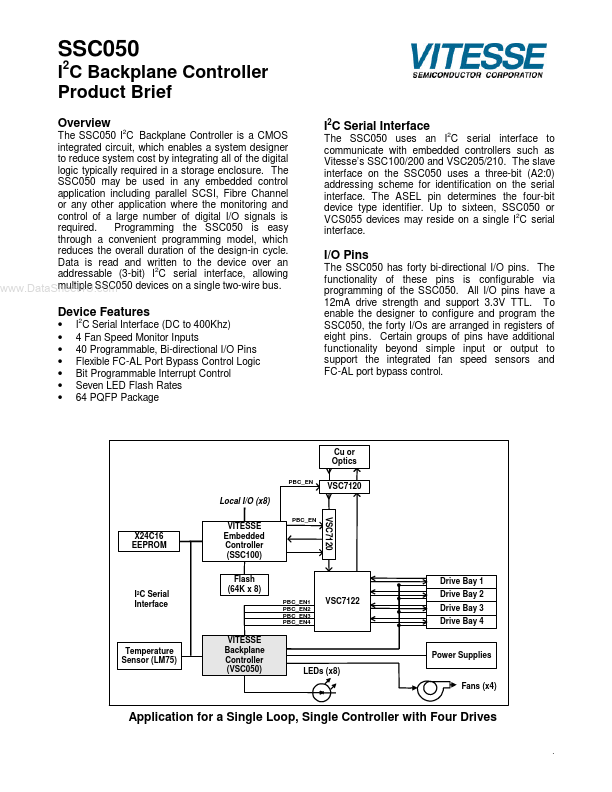
Overview I2C Serial Interface The SSC050 uses an I2C serial interface to municate with embedded controllers such as Vitesse’ s SSC100/200 and VSC205/210. The slave interface on the SSC050 uses a three-bit (A2:0) addressing scheme for identification on the serial interface. The ASEL pin determines the four-bit device type identifier. Up to sixteen, SSC050 or VCS055 devices may reside on a single I2C serial interface. I/O Pins The SSC050 has forty bi-directional I/O pins. The functionality of these pins is configurable via programming of the SSC050. All I/O pins have a 12m A drive strength and support 3.3V TTL. To enable the designer to configure and program the SSC050, the forty I/Os are arranged in registers of eight pins. Certain groups of pins have additional functionality beyond simple input or output to support the integrated fan speed sensors and FC-AL port bypass control. Device Features I2C Serial Interface (DC to 400Khz) 4 Fan Speed Monitor Inputs 40 Programmable, Bi-directional I/O Pins Flexible FC-AL Port Bypass Control Logic Bit Programmable Interrupt Control Seven LED Flash Rates 64 PQFP Package Cu or Optics PBC_EN VSC7120 Local I/O (x8) VSC7120 VITESSE Embedded Controller (SSC100) Flash (64K x 8) PBC_EN1 PBC_EN2 PBC_EN3 PBC_EN4 PBC_EN X24C16 EEPROM Drive Bay 1 VSC7122 Drive Bay 2 Drive Bay 3 Drive Bay 4 I C Serial Interface Temperature Sensor (LM75) VITESSE Backplane Controller (VSC050) Power Supplies LEDs (x8) Fans (x4) Application for a Single Loop, Single Controller with Four Drives . LED Flash Rate Control The built-in flexibility of the SSC050 allows all forty of the I/O pins to drive LEDs through a pull-up resistor. Each pin is independently programmed to flash an LED at one of seven predefined flash rates. FC-AL Port Bypass Control Up to sixteen of the forty I/Os may be configured to monitor and manage FC-AL port bypass control devices. Eight pairs of I/Os include special logic to monitor Enable Bypass signals, which may be...