AP603
AP603 is High Dynamic Range HBT Amplifier manufactured by WJ Communications.
Features
- 800
- 2200 MHz
- +38.5 d Bm P1d B
- -50 d Bc ACLR @ 1W PAVG
- -51 d Bc IMD3 @ 1W PEP
- 15% Efficiency @ 1W PAVG
- -
- -
Product Description
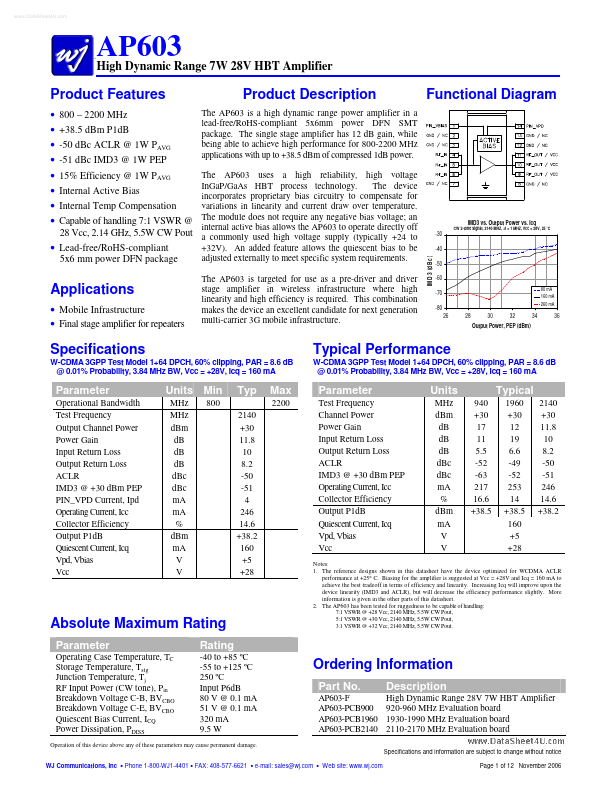
The AP603 is a high dynamic range power amplifier in a lead-free/Ro HS-pliant 5x6mm power DFN SMT package. The single stage amplifier has 12 d B gain, while being able to achieve high performance for 800-2200 MHz applications with up to +38.5 d Bm of pressed 1d B power.
Functional Diagram
IM D 3 (d B c)
The AP603 uses a high reliability, high voltage In Ga P/Ga As HBT process technology. The device Internal Active Bias incorporates proprietary bias circuitry to pensate for Internal Temp pensation variations in linearity and current draw over temperature. Capable of handling 7:1 VSWR @ The module does not require any negative bias voltage; an internal active bias allows the AP603 to operate directly off 28 Vcc, 2.14 GHz, 5.5W CW Pout a monly used high voltage supply (typically +24 to +32V). An added feature allows the quiescent bias to be Lead-free/Ro HS-pliant adjusted externally to meet specific system requirements. 5x6 mm power DFN package The AP603 is targeted for use as a pre-driver and driver stage amplifier in wireless infrastructure where high linearity and high efficiency is required. This bination makes the device an excellent candidate for next generation multi-carrier 3G mobile infrastructure.
IMD3 vs. Output Power vs. Icq -30 -40 -50 -60 -70 -80 26 28 30 32 34 Output Power, PEP (d Bm)
80 m A 160 m A 260 m A
CW 2-tone signal, 2140 MHz, ∆f = 1 MHz, Vcc = 28V, 25 ˚C
Applications
- Mobile Infrastructure
- Final stage amplifier for repeaters
Specifications
W-CDMA 3GPP Test Model 1+64 DPCH, 60% clipping, PAR = 8.6 d B @ 0.01% Probability, 3.84 MHz BW, Vcc = +28V, Icq = 160 m A
Typical Performance
W-CDMA 3GPP Test Model 1+64 DPCH, 60% clipping, PAR = 8.6 d B @ 0.01% Probability, 3.84 MHz BW, Vcc = +28V, Icq = 160 m A
Parameter
Operational Bandwidth Test Frequency Output Channel Power Power Gain Input Return Loss Output...