U630H04
U630H04 is Hardstore 512x8 Nvsram manufactured by ZMD.
Preliminary
Hard Store 512 x 8 nv SRAM
Features
F Packages:
Description
F High-performance CMOS nonvolatile static RAM 512 x 8 bits F 25 and 45 ns Access Times F 12 and 25 ns Output Enable Access Times F Unlimited Read and Write to SRAM F Hardware STORE Initiation (STORE Cycle Time < 10 ms) F Automatic STORE Timing F 10 STORE cycles to EEPROM F 10 years data retention in EEPROM F Automatic RECALL on Power Up F Hardware RECALL Initiation .. (RECALL Cycle Time < 20 µs) F Unlimited RECALL cycles from EEPROM F Single 5 V ± 10 % Operation F Operating temperature ranges:
PDIP28 (300 mil) PDIP28 (600 mil) SOP28 (300 mil)
0 to 70 °C -40 to 85 °C CECC 90000 Quality Standard ESD characterization according MIL STD 883C M3015.7-HBM
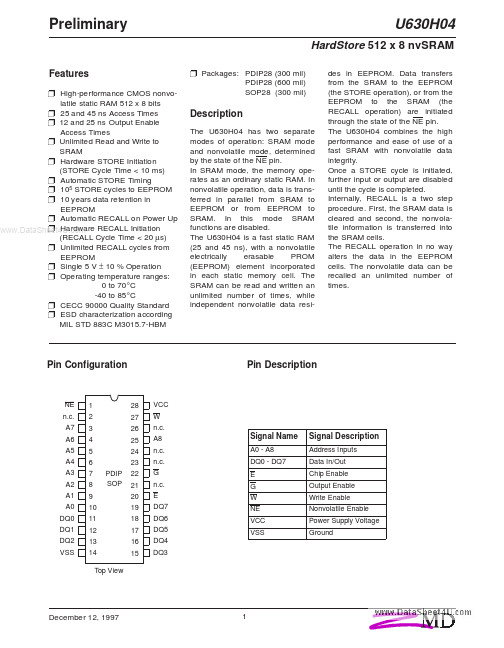
The U630H04 has two separate modes of operation: SRAM mode and nonvolatile mode, determined by the state of the NE pin. In SRAM mode, the memory operates as an ordinary static RAM. In nonvolatile operation, data is transferred in parallel from SRAM to EEPROM or from EEPROM to SRAM. In this mode SRAM functions are disabled. The U630H04 is a fast static RAM (25 and 45 ns), with a nonvolatile electrically erasable PROM (EEPROM) element incorporated in each static memory cell. The SRAM can be read and written an unlimited number of times, while independent nonvolatile data resi- des in EEPROM. Data transfers from the SRAM to the EEPROM (the STORE operation), or from the EEPROM to the SRAM (the RECALL operation) are initiated through the state of the NE pin. The U630H04 bines the high performance and ease of use of a fast SRAM with nonvolatile data integrity. Once a STORE cycle is initiated, further input or output are disabled until the cycle is pleted. Internally, RECALL is a two step procedure. First, the SRAM data is cleared and second, the nonvolatile information is transferred into the SRAM cells. The RECALL operation in no way alters the data in the EEPROM cells. The nonvolatile data can be recalled an...