AN47
AN47 is Getting more out of the ZXLD1350 - dimming techniques manufactured by Zetex Semiconductors.
..
AN47 Getting more out of the ZXLD1350
- dimming techniques
Ray Liu, Systems Engineer, Zetex Semiconductors
Introduction
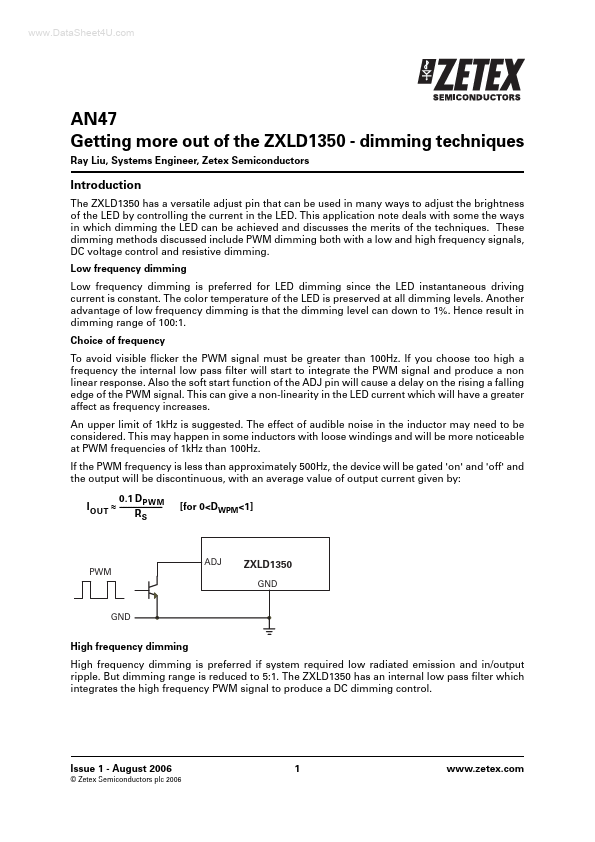
The ZXLD1350 has a versatile adjust pin that can be used in many ways to adjust the brightness of the LED by controlling the current in the LED. This application note deals with some the ways in which dimming the LED can be achieved and discusses the merits of the techniques. These dimming methods discussed include PWM dimming both with a low and high frequency signals, DC voltage control and resistive dimming. Low frequency dimming Low frequency dimming is preferred for LED dimming since the LED instantaneous driving current is constant. The color temperature of the LED is preserved at all dimming levels. Another advantage of low frequency dimming is that the dimming level can down to 1%. Hence result in dimming range of 100:1. Choice of frequency To avoid visible flicker the PWM signal must be greater than 100Hz. If you choose too high a frequency the internal low pass filter will start to integrate the PWM signal and produce a non linear response. Also the soft start function of the ADJ pin will cause a delay on the rising a falling edge of the PWM signal. This can give a non-linearity in the LED current which will have a greater affect as frequency increases. An upper limit of 1k Hz is suggested. The effect of audible noise in the inductor may need to be considered. This may happen in some inductors with loose windings and will be more noticeable at PWM frequencies of 1k Hz than 100Hz. If the PWM frequency is less than approximately 500Hz, the device will be gated 'on' and 'off' and the output will be discontinuous, with an average value of output current given by: 0.1 D PWM I OUT ≈ ------------------------RS [for 0<DWPM<1]
ADJ PWM
ZXLD1350
High frequency dimming High frequency dimming is preferred if system required low radiated emission and in/output ripple. But dimming range is reduced to 5:1. The ZXLD1350 has an internal low...