Datasheet4U Logo Datasheet4U.com

AS1310 - Hysteretic DC-DC Step-Up Converter

General Description

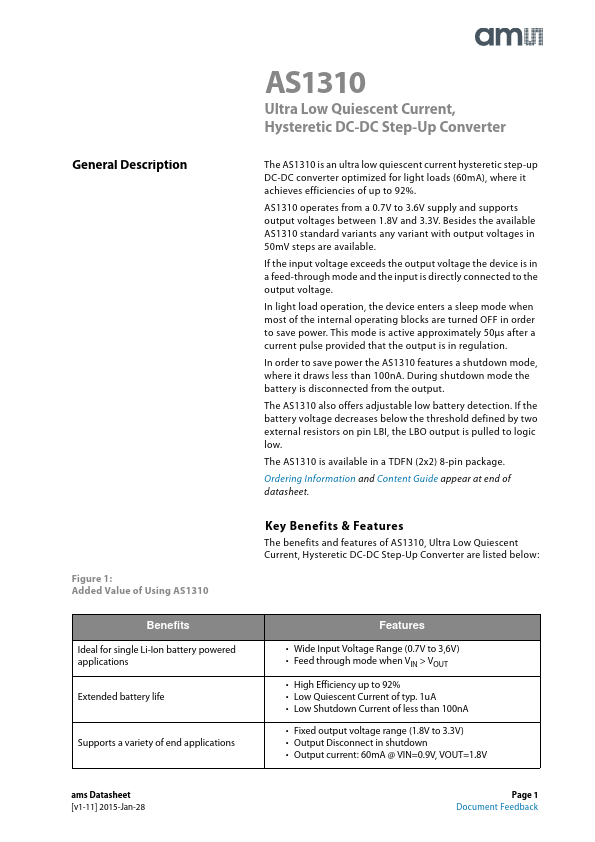
Figure 1: Added Value of Using AS1310 Benefits Ideal for single Li-Ion battery powered applications Extended battery life Supports a variety of end applications The AS1310 is an ultra low quiescent current hysteretic step-up DC-DC converter optimized for light loads (60mA), where it achieves effici

Key Features

  • a shutdown mode, where it draws less than 100nA. During shutdown mode the battery is disconnected from the output. The AS1310 also offers adjustable low battery detection. If the battery voltage decreases below the threshold defined by two external resistors on pin LBI, the LBO output is pulled to logic low. The AS1310 is available in a TDFN (2x2) 8-pin package. Ordering Information and Content Guide appear at end of datasheet. Key Benefits & Features The benefits and features of AS1310, Ultra L.

📥 Download Datasheet

Datasheet Details

Part number AS1310
Manufacturer ams OSRAM
File Size 352.32 KB
Description Hysteretic DC-DC Step-Up Converter
Datasheet download datasheet AS1310 Datasheet

Full PDF Text Transcription (Reference)

The following content is an automatically extracted verbatim text from the original manufacturer datasheet and is provided for reference purposes only.

View original datasheet text
AS1310 Ultra Low Quiescent Current, Hysteretic DC-DC Step-Up Converter General Description Figure 1: Added Value of Using AS1310 Benefits Ideal for single Li-Ion battery powered applications Extended battery life Supports a variety of end applications The AS1310 is an ultra low quiescent current hysteretic step-up DC-DC converter optimized for light loads (60mA), where it achieves efficiencies of up to 92%. AS1310 operates from a 0.7V to 3.6V supply and supports output voltages between 1.8V and 3.3V. Besides the available AS1310 standard variants any variant with output voltages in 50mV steps are available. If the input voltage exceeds the output voltage the device is in a feed-through mode and the input is directly connected to the output voltage.