Datasheet4U Logo Datasheet4U.com

AS1923 - Quad-Voltage Microprocessor Supervisory

General Description

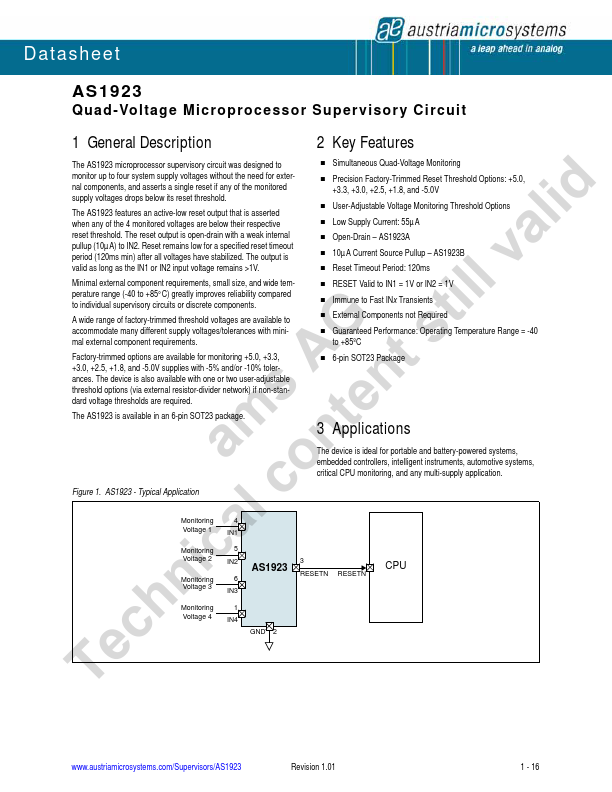
The AS1923 microprocessor supervisory circuit was designed to monitor up to four system supply voltages without the need for external components, and asserts a single reset if any of the monitored supply voltages drops below its reset threshold.

Key Features

  • an active-low reset output that is asserted when any of the 4 monitored voltages are below their respective reset threshold. The reset output is open-drain with a weak internal pullup (10µA) to IN2. Reset remains low for a specified reset timeout period (120ms min) after all voltages have stabilized. The output is valid as long as the IN1 or IN2 input voltage remains >1V. Minimal external component requirements, small size, and wide temperature range (-40 to +85°C) greatly improves reliability c.

📥 Download Datasheet

Datasheet Details

Part number AS1923
Manufacturer austriamicrosystems AG
File Size 698.46 KB
Description Quad-Voltage Microprocessor Supervisory
Datasheet download datasheet AS1923 Datasheet

Full PDF Text Transcription (Reference)

The following content is an automatically extracted verbatim text from the original manufacturer datasheet and is provided for reference purposes only.

View original datasheet text
www.DataSheet4U.com AS1923 Q u a d - Vo l ta g e M i c r o p r o c e s s o r S u p e r v i s o r y C i r c u i t Product Brief 1 General Description The AS1923 microprocessor supervisory circuit was designed to monitor up to four system supply voltages without the need for external components, and asserts a single reset if any of the monitored supply voltages drops below its reset threshold. The AS1923 features an active-low reset output that is asserted when any of the 4 monitored voltages are below their respective reset threshold. The reset output is open-drain with a weak internal pullup (10µA) to IN2. Reset remains low for a specified reset timeout period (120ms min) after all voltages have stabilized. The output is valid as long as the IN1 or IN2 input voltage remains >1V.