

Datasheet4U Logo Datasheet4U.com

AS3502 - Low Power Ambient Noise-Cancelling Speaker Driver

This page provides the datasheet information for the AS3502, a member of the AS3501 Low Power Ambient Noise-Cancelling Speaker Driver family.

Datasheet Summary

Description

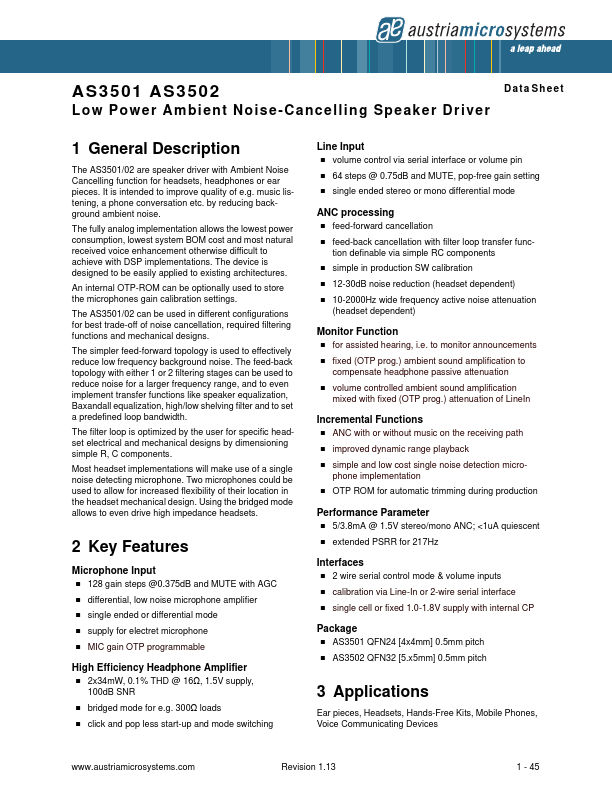
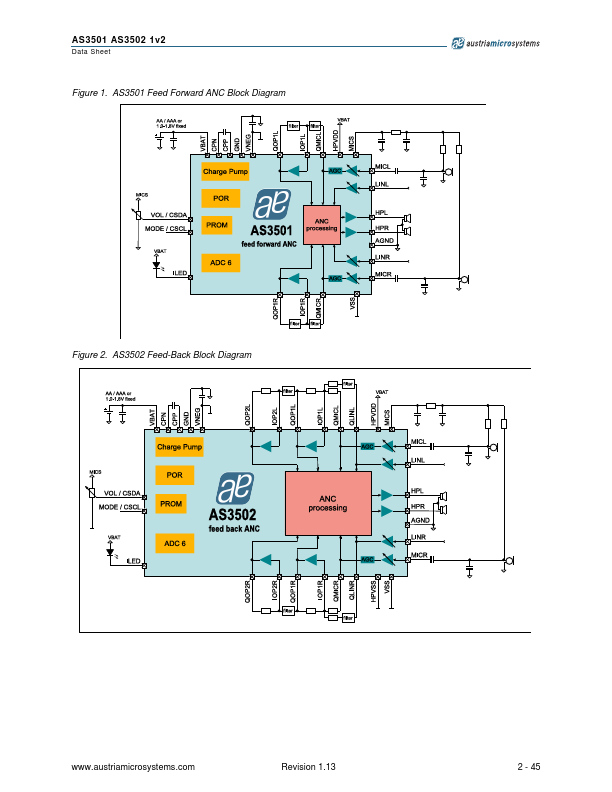
The AS3501/02 are speaker driver with Ambient Noise Cancelling function for headsets, headphones or ear pieces.

It is intended to improve quality of e.g.

music listening, a phone conversation etc.

Features

  • Microphone Input 128 gain steps @0.375dB and MUTE with AGC differential, low noise microphone amplifier single ended or differential mode supply for electret microphone MIC gain OTP programmable High Efficiency Headphone Amplifier 2x34mW, 0.1% THD @ 16Ω, 1.5V supply, 100dB SNR bridged mode for e. g. 300Ω loads click and pop less start-up and mode switching Line Input volume control via serial interface or volume pin 64 steps @ 0.75dB and MUTE, pop-free gain setting single ended stereo or mono di.

📥 Download Datasheet

Datasheet preview – AS3502

Datasheet Details

Part number AS3502
Manufacturer austriamicrosystems AG
File Size 1.70 MB
Description Low Power Ambient Noise-Cancelling Speaker Driver
Datasheet download datasheet AS3502 Datasheet
Additional preview pages of the AS3502 datasheet.
Other Datasheets by austriamicrosystems AG

Full PDF Text Transcription

Click to expand full text
AS3501 AS3502 Data Sheet Low Power Ambient Noise-Cancelling Speaker Driver 1 General Description The AS3501/02 are speaker driver with Ambient Noise Cancelling function for headsets, headphones or ear pieces. It is intended to improve quality of e.g. music listening, a phone conversation etc. by reducing background ambient noise. The fully analog implementation allows the lowest power consumption, lowest system BOM cost and most natural received voice enhancement otherwise difficult to achieve with DSP implementations. The device is designed to be easily applied to existing architectures. An internal OTP-ROM can be optionally used to store the microphones gain calibration settings.
Published: |