Texas Instruments 74F373
The eight latches of the ′F373 are transparent D-type latches. When the latch enable is taken low, the Q outputs are latched at the logic levels set up at the D inputs.| Part No. | 74F373 |
|---|---|
| Datasheet | 74F373 Download |
| Manufacturer |  Texas Instruments |
| Description | OCTAL TRANSPARENT D-TYPE LATCHES |
| Buy | Stock & Price |

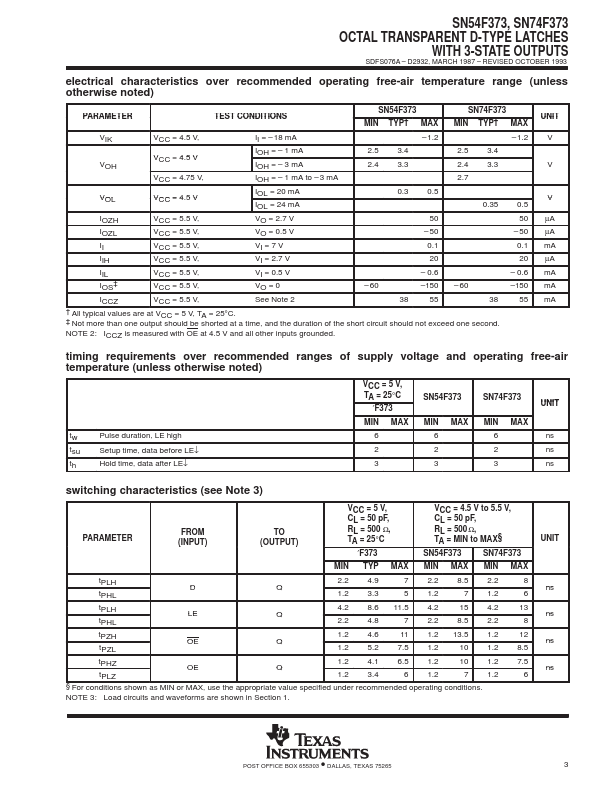
SN54F373, SN74F373 OCTAL TRANSPARENT D-TYPE LATCHES WITH 3-STATE OUTPUTS SDFS076A – D2932, MARCH 1987 – REVISED OCTOBER 1993
● Eight Latches in a Single Package
● 3-State Bus-Driving True Outputs
● Full Parallel Access for Loading
● Buffered Control Inputs
● Package Options Include Plastic Small-Outline (SOIC) and Shrink Small-Outline (SSOP) Packages, Ceramic Chip Carriers, and Plastic and Ceramic DIPs description These 8-bit latches feature 3-state outputs designed specifically for driving highly capacitive or relatively low-impedance loads. They are particularly suitable for implementing buffer registers, I/O ports, bidirectional bus drivers, and working registers. SN54F373 . . . J PACKAGE SN74F373 . . . DB, DW, OR N PACKAGE (TOP VIEW) OE 1 1Q 2 1D 3 2D 4 2Q 5 3Q 6 3D 7 4D 8 4Q 9 GND 10 20 VCC 19 8Q 18 8D 17 7D 16 7Q 15 6Q 14 6D 13 5D 12 5Q 11 LE SN54F373 . . . FK PACKAGE (TOP VIEW) 8Q VCC OE 1Q 1D While the latch-enable (LE) input is high, the Q outputs will follow the data (D) inputs.