Datasheet4U Logo Datasheet4U.com

ADS1178 - 16-Bit Analog-to-Digital Converter

Download the ADS1178 datasheet PDF. This datasheet also covers the ADS1174 variant, as both devices belong to the same 16-bit analog-to-digital converter family and are provided as variant models within a single manufacturer datasheet.

General Description

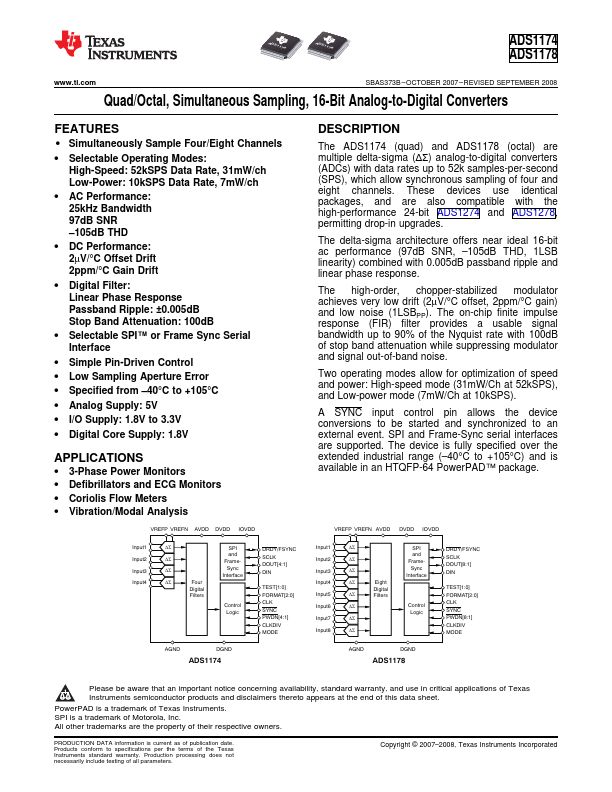
The ADS1174 (quad) and ADS1178 (octal) are multiple delta-sigma (ΔΣ) analog-to-digital converters (ADCs) with data rates up to 52k samples-per-second (SPS), which allow synchronous sampling of four and eight channels.

Key Features

  • 1.
  • 234 Simultaneously Sample Four/Eight Channels.
  • Selectable Operating Modes: High-Speed: 52kSPS Data Rate, 31mW/ch Low-Power: 10kSPS Data Rate, 7mW/ch.
  • AC Performance: 25kHz Bandwidth 97dB SNR.
  • 105dB THD.
  • DC Performance: 2µV/°C Offset Drift 2ppm/°C Gain Drift.
  • Digital Filter: Linear Phase Response Passband Ripple: ±0.005dB Stop Band Attenuation: 100dB.
  • Selectable SPI™ or Frame Sync Serial Interface.
  • Simple Pin-Driven Control.

📥 Download Datasheet

Note: The manufacturer provides a single datasheet file (ADS1174-etcTI.pdf) that lists specifications for multiple related part numbers.

Full PDF Text Transcription (Reference)

The following content is an automatically extracted verbatim text from the original manufacturer datasheet and is provided for reference purposes only.

View original datasheet text
ADS1174 ADS1178 ADS1174 ADS1178 www.ti.com ........................................................................................................................................ SBAS373B – OCTOBER 2007 – REVISED SEPTEMBER 2008 Quad/Octal, Simultaneous Sampling, 16-Bit Analog-to-Digital Converters FEATURES 1 •234 Simultaneously Sample Four/Eight Channels • Selectable Operating Modes: High-Speed: 52kSPS Data Rate, 31mW/ch Low-Power: 10kSPS Data Rate, 7mW/ch • AC Performance: 25kHz Bandwidth 97dB SNR –105dB THD • DC Performance: 2µV/°C Offset Drift 2ppm/°C Gain Drift • Digital Filter: Linear Phase Response Passband Ripple: ±0.