ADS62P23
ADS62P23 is Analog-to-Digital Converters manufactured by Texas Instruments.
- Part of the ADS62P22 comparator family.
- Part of the ADS62P22 comparator family.
FEATURES
- Maximum Sample Rate: 125 MSPS
- 12-Bit Resolution with No Missing Codes
- 95 d B Crosstalk
- Parallel CMOS and DDR LVDS Output Options
- 3.5 d B Coarse Gain and Programmable Fine
Gain up to 6 d B for SNR/SFDR Trade-Off
- Digital Processing Block with:
- Offset Correction
- Fine Gain Correction, in Steps of 0.05 d B
- Decimation by 2/4/8
- Built-in and Custom Programmable 24-Tap
Low-/High-/Band-Pass Filters
- Supports Sine, LVPECL, LVDS, and LVCMOS
Clocks and Amplitude Down to 400 m VPP
- Clock Duty Cycle Stabilizer
- Internal Reference; Supports External
Reference also
- 64-QFN Package (9mm × 9mm)
- Pin patible 14-Bit Family (ADS62P4X)
APPLICATIONS
- Wireless munications Infrastructure
- Software Defined Radio
- Power Amplifier Linearization
- 802.16d/e
- Test and Measurement Instrumentation
- High Definition Video
- Medical Imaging
- Radar Systems
DESCRIPTION
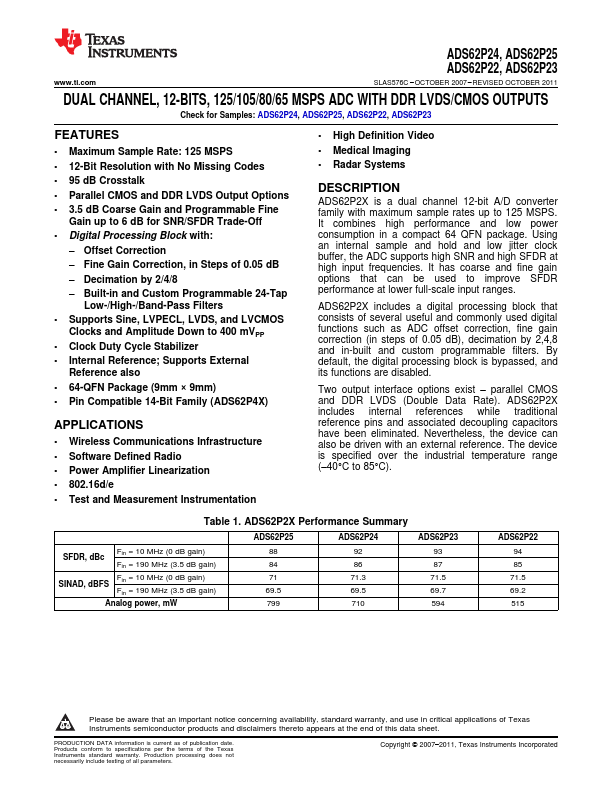
ADS62P2X is a dual channel 12-bit A/D converter family with maximum sample rates up to 125 MSPS. It bines high performance and low power consumption in a pact 64 QFN package. Using an internal sample and hold and low jitter clock buffer, the ADC supports high SNR and high SFDR at high input frequencies. It has coarse and fine gain options that can be used to improve SFDR performance at lower full-scale input ranges.
ADS62P2X includes a digital processing block that consists of several useful and monly used digital functions such as ADC offset correction, fine gain correction (in steps of 0.05 d B), decimation by 2,4,8 and in-built and custom programmable filters. By default, the digital processing block is bypassed, and its functions are disabled.
Two output interface options exist
- parallel CMOS and DDR LVDS (Double Data Rate). ADS62P2X includes internal references while traditional reference pins and associated decoupling capacitors have been eliminated. Nevertheless, the device can also be driven with an external reference. The device is specified over the industrial temperature range (- 40°C to...