LM236-2.5-N
LM236-2.5-N is Reference Diode manufactured by Texas Instruments.
LM136-2.5-N
.ti.
SNVS749F
- MAY 1998
- REVISED APRIL 2013
LM136-2.5-N, LM236-2.5-N, LM336-2.5-NV Reference Diode
Check for Samples: LM136-2.5-N
Features
- 2 Low Temperature Coefficient
- Wide Operating Current of 400 μA to 10 m A
- 0.2Ω Dynamic Impedance
- ±1% Initial Tolerance Available
- Specified Temperature Stability
- Easily Trimmed for Minimum Temperature Drift
- Fast Turn-On
DESCRIPTION
The LM136-2.5-N/LM236-2.5-N and LM336-2.5-N integrated circuits are precision 2.5V shunt regulator diodes. These monolithic IC voltage references operate as a low-temperature-coefficient 2.5V zener with 0.2Ω dynamic impedance. A third terminal on the LM136-2.5-N allows the reference voltage and temperature coefficient to be trimmed easily.
The LM136-2.5-N series is useful as a precision 2.5V low voltage reference for digital voltmeters, power supplies or op amp circuitry. The 2.5V make it convenient to obtain a stable reference from 5V logic supplies. Further, since the LM136-2.5-N operates as a shunt regulator, it can be used as either a positive or negative voltage reference.
The LM136-2.5-N is rated for operation over
- 55°C to +125°C while the LM236-2.5-N is rated over a
- 25°C to +85°C temperature range.
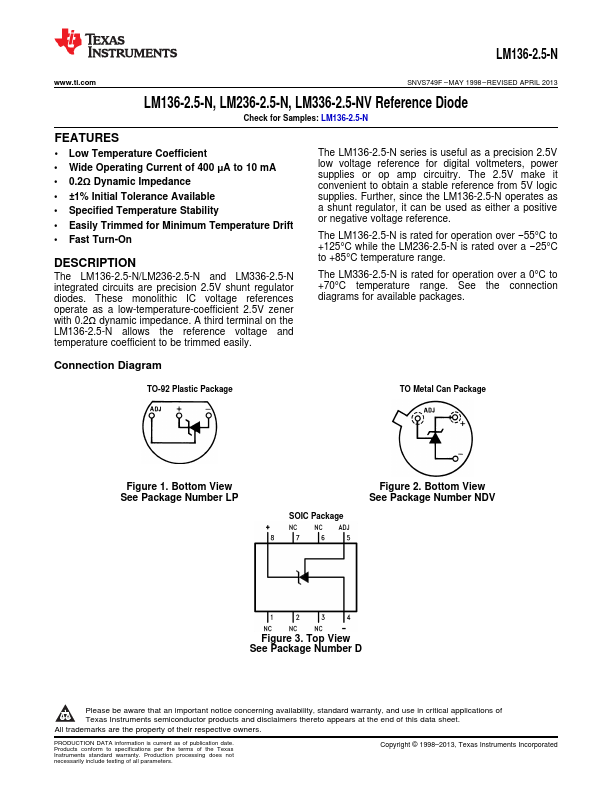
The LM336-2.5-N is rated for operation over a 0°C to +70°C temperature range. See the connection diagrams for available packages.
Connection Diagram
TO-92 Plastic Package
TO Metal Can Package
Figure 1. Bottom View See Package Number LP
SOIC Package
Figure 2. Bottom View See Package Number NDV
Figure 3. Top View See Package Number D
Please be aware that an important notice concerning availability, standard warranty, and use in critical applications of Texas Instruments semiconductor products and disclaimers thereto appears at the end of this data sheet. All trademarks are the property of their respective...