LMX2582
LMX2582 is RF Synthesizer manufactured by Texas Instruments.
Features
- Output Frequency Range from 20 to 5500 MHz
- Industry Leading Phase Noise Performance
- VCO Phase Noise:
- 144.5 d Bc/Hz at 1-MHz Offset for 1.8-GHz Output
- Normalized PLL Noise Floor:
- 231 d Bc/Hz
- Normalized PLL Flicker Noise:
- 126 d Bc/Hz
- 47-fs RMS Jitter (12 k Hz to 20 MHz) for 1.8
GHz Output
- Input Clock Frequency Up to 1400 MHz
- Phase Detector Frequency Up to 200 MHz, and Up to 400 MHz in Integer-N Mode
- Supports Fractional-N and Integer-N Modes
- Dual Differential Outputs
- Innovative Solution to Reduce Spurs
- Programmable Phase Adjustment
- Programmable Charge Pump Current
- Programmable Output Power Level
- SPI or u Wire (4-Wire Serial Interface)
- Single Power Supply Operation: 3.3 V
2 Applications
- Test and Measurement Equipment
- Cellular Base-Station
- Microwave Backhaul
- High-Performance Clock Source for High-Speed
Data Converters
- Software Defined Radio
3 Description
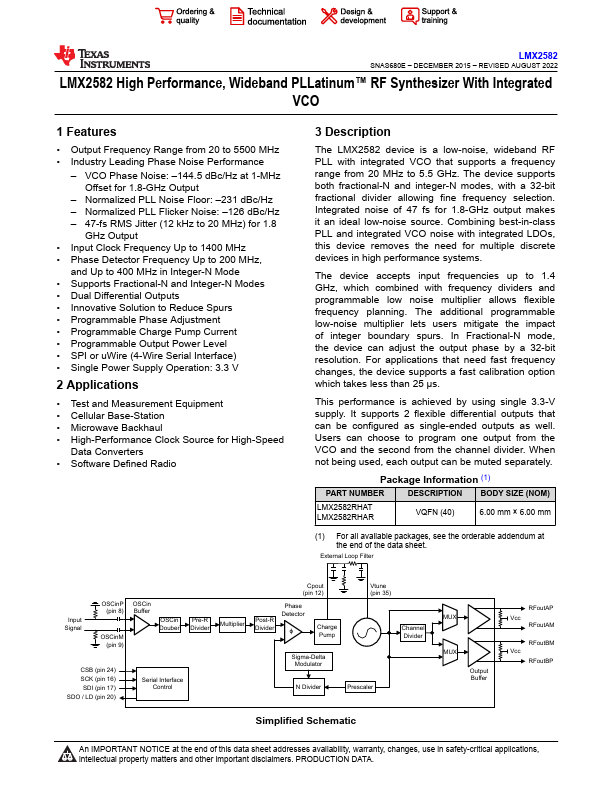
The LMX2582 device is a low-noise, wideband RF PLL with integrated VCO that supports a frequency range from 20 MHz to 5.5 GHz. The device supports both fractional-N and integer-N modes, with a 32-bit fractional divider allowing fine frequency selection. Integrated noise of 47 fs for 1.8-GHz output makes it an ideal low-noise source. bining best-in-class PLL and integrated VCO noise with integrated LDOs, this device removes the need for multiple discrete devices in high performance systems.
The device accepts input frequencies up to 1.4 GHz, which bined with frequency dividers and programmable low noise multiplier allows flexible frequency planning. The additional programmable low-noise multiplier lets users mitigate the impact of integer boundary spurs. In Fractional-N mode, the device can adjust the output phase by a 32-bit resolution. For applications that need fast frequency changes, the device supports a fast calibration option which takes less than 25 µs.
This performance is achieved by using single 3.3-V supply. It supports 2 flexible differential outputs that...