SN105125
SN105125 is 150-mA Low Dropout Regulator manufactured by Texas Instruments.
SN105125 150Ćm A LOW DROPOUT REGULATOR WITH POK
Features
D Low Dropout Voltage Regulator, 1.2-V D 150-m A Load Current Capability D Power Okay (POK) Function D Load Independent, Low Ground
Current,150-µA
D Current Limiting D Thermal Shutdown D Low Sleep State Current (Off Mode) D Fast Transient Response D Low Variation Due to Load and Line
Regulation
D Output Stable With Low ESR Capacitors D TTL Logic Controlled Enable Input
SLVS418
- JANUARY 2002 DBV PACKAGE
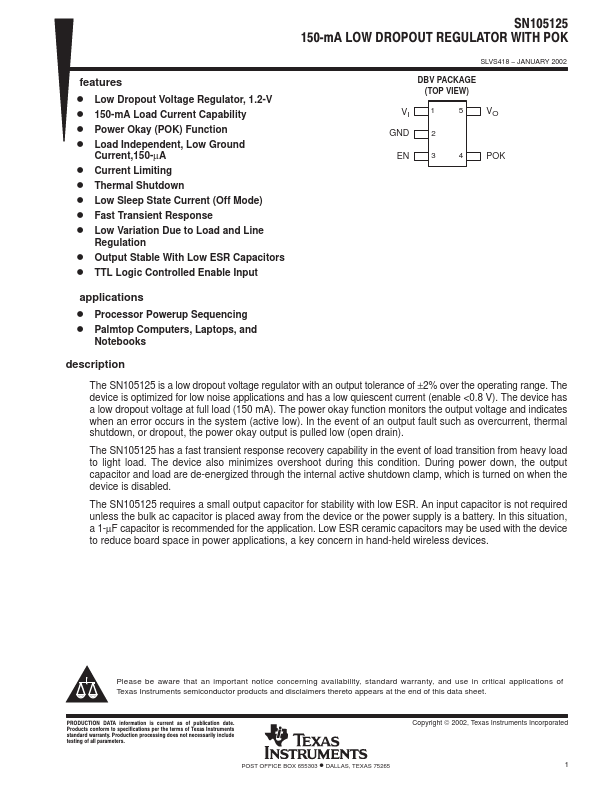
(TOP VIEW) VI 1 5 VO GND 2
EN 3 4 POK applications
D Processor Powerup Sequencing D Palmtop puters, Laptops, and
Notebooks description
The SN105125 is a low dropout voltage regulator with an output tolerance of ±2% over the operating range. The device is optimized for low noise applications and has a low quiescent current (enable <0.8 V). The device has a low dropout voltage at full load (150 m A). The power okay function monitors the output voltage and indicates when an error occurs in the system (active low). In the event of an output fault such as overcurrent, thermal shutdown, or dropout, the power okay output is pulled low (open drain).
The SN105125 has a fast transient response recovery capability in the event of load transition from heavy load to light load. The device also minimizes overshoot during this condition. During power down, the output capacitor and load are de-energized through the internal active shutdown clamp, which is turned on when the device is disabled.
The SN105125 requires a small output capacitor for stability with low ESR. An input capacitor is not required unless the bulk ac capacitor is placed away from the device or the power supply is a battery. In this situation, a 1-µF capacitor is remended for the application. Low ESR ceramic capacitors may be used with the device to reduce board space in power applications, a key concern in hand-held wireless devices.
Please be aware that an important notice concerning availability, standard warranty, and use in critical...