• Part: SN55HVD75-EP
  • Description: 3.3-V Supply RS-485
  • Manufacturer: Texas Instruments
  • Size: 1.45 MB
Download SN55HVD75-EP Datasheet PDF
Texas Instruments
SN55HVD75-EP
SN55HVD75-EP is 3.3-V Supply RS-485 manufactured by Texas Instruments.
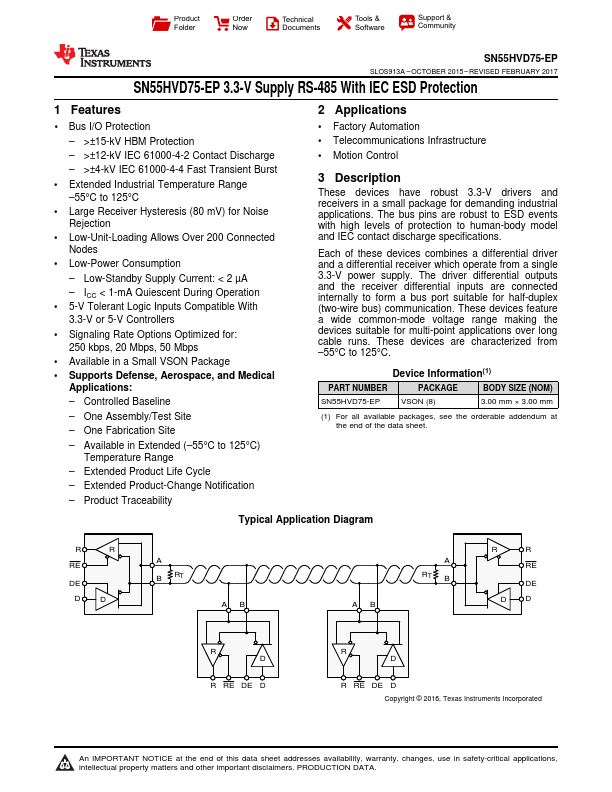
Features - 1 Bus I/O Protection - >±15-k V HBM Protection - >±12-k V IEC 61000-4-2 Contact Discharge - >±4-k V IEC 61000-4-4 Fast Transient Burst - Extended Industrial Temperature Range - 55°C to 125°C - Large Receiver Hysteresis (80 m V) for Noise Rejection - Low-Unit-Loading Allows Over 200 Connected Nodes - Low-Power Consumption - Low-Standby Supply Current: < 2 µA - ICC < 1-m A Quiescent During Operation - 5-V Tolerant Logic Inputs patible With 3.3-V or 5-V Controllers - Signaling Rate Options Optimized for: 250 kbps, 20 Mbps, 50 Mbps - Available in a Small VSON Package - Supports Defense, Aerospace, and Medical Applications: - Controlled Baseline - One Assembly/Test Site - One Fabrication Site - Available in Extended (- 55°C to 125°C) Temperature Range - Extended Product Life Cycle - Extended Product-Change Notification - Product Traceability 2 Applications - Factory Automation - Telemunications Infrastructure - Motion Control 3 Description These devices have robust 3.3-V drivers and receivers in a small package for demanding industrial applications. The bus pins are robust to ESD events with high levels of protection to human-body model and IEC contact discharge specifications. Each of these devices bines a differential driver and a differential receiver which operate from a single 3.3-V power supply. The driver differential outputs and the receiver differential inputs are connected internally to form a bus port suitable for half-duplex (two-wire bus) munication. These devices feature a wide mon-mode voltage range making the devices suitable for multi-point applications over long cable runs. These devices are characterized from - 55°C to 125°C. Device Information(1) PART NUMBER PACKAGE BODY SIZE (NOM) VSON (8) 3.00 mm × 3.00 mm (1) For all available packages, see the orderable addendum at the end of the data...