SN65LVCP22
SN65LVCP22 is 2x2 LVDS CROSSPOINT SWITCH manufactured by Texas Instruments.
FEATURES
- High Speed (>1000 Mbps) Upgrade for DS90CP22 2x2 LVDS Crosspoint Switch
- LVPECL Crosspoint Switch Available in SN65LVCP23
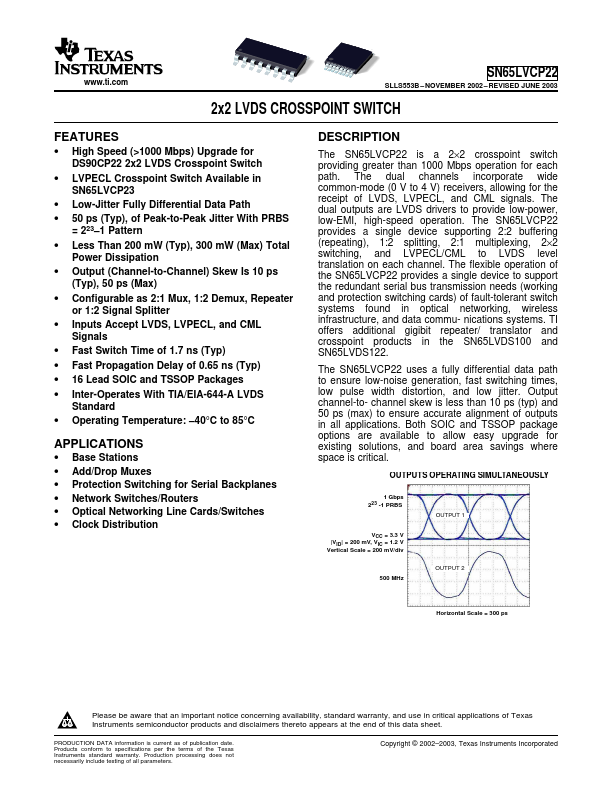
- Low-Jitter Fully Differential Data Path
- 50 ps (Typ), of Peak-to-Peak Jitter With PRBS
= 223- 1 Pattern
- Less Than 200 m W (Typ), 300 m W (Max) Total Power Dissipation
- Output (Channel-to-Channel) Skew Is 10 ps (Typ), 50 ps (Max)
- Configurable as 2:1 Mux, 1:2 Demux, Repeater or 1:2 Signal Splitter
- Inputs Accept LVDS, LVPECL, and CML Signals
- Fast Switch Time of 1.7 ns (Typ)
- Fast Propagation Delay of 0.65 ns (Typ)
- 16 Lead SOIC and TSSOP Packages
- Inter-Operates With TIA/EIA-644-A LVDS
Standard
- Operating Temperature:
- 40°C to 85°C
APPLICATIONS
- Base Stations
- Add/Drop Muxes
- Protection Switching for Serial Backplanes
- Network Switches/Routers
- Optical Networking Line Cards/Switches
- Clock Distribution
DESCRIPTION
The SN65LVCP22 is a 2×2 crosspoint switch providing greater than 1000 Mbps operation for each path. The dual channels incorporate wide mon-mode (0 V to 4 V) receivers, allowing for the receipt of LVDS, LVPECL, and CML signals. The dual outputs are LVDS drivers to provide low-power, low-EMI, high-speed operation. The SN65LVCP22 provides a single device supporting 2:2 buffering (repeating), 1:2 splitting, 2:1 multiplexing, 2×2 switching, and LVPECL/CML to LVDS level translation on each channel. The flexible operation of the SN65LVCP22 provides a single device to support the redundant serial bus transmission needs (working and protection switching cards) of fault-tolerant switch systems found in optical networking, wireless infrastructure, and data mu- nications systems. TI offers additional gigibit repeater/ translator and crosspoint products in the SN65LVDS100 and SN65LVDS122.
The SN65LVCP22 uses a fully differential data path to ensure low-noise generation, fast switching times, low pulse width distortion, and low jitter. Output channel-to- channel skew is less than 10 ps (typ) and 50 ps (max) to ensure...