SN65LVDM176
SN65LVDM176 is HIGH-SPEED DIFFERENTIAL LINE TRANSCEIVER manufactured by Texas Instruments.
FEATURES
- Low-Voltage Differential Driver and Receiver for Half-Duplex Operation
- Designed for Signaling Rates of 400 Mbit/s
- ESD Protection Exceeds 15 k V on Bus Pins
- Operates From a Single 3.3-V Supply
- Low-Voltage Differential Signaling With
Typical Output Voltages of 350 m V and a 50-Ω Load
- Valid Output With as Little as 50 m V Input Voltage Difference
- Propagation Delay Times
- Driver: 1.7 ns Typ
- Receiver: 3.7 ns Typ
- Power Dissipation at 200 MHz
- Driver: 50 m W Typical
- Receiver: 60 m W Typical
- LVTTL Levels Are 5-V Tolerant
- Bus Pins Are High Impedance When Disabled or With VCC Less Than 1.5 V
- Open-Circuit Fail-Safe Receiver
- Surface-Mount Packaging
- D Package (SOIC)
- DGK Package (MSOP)
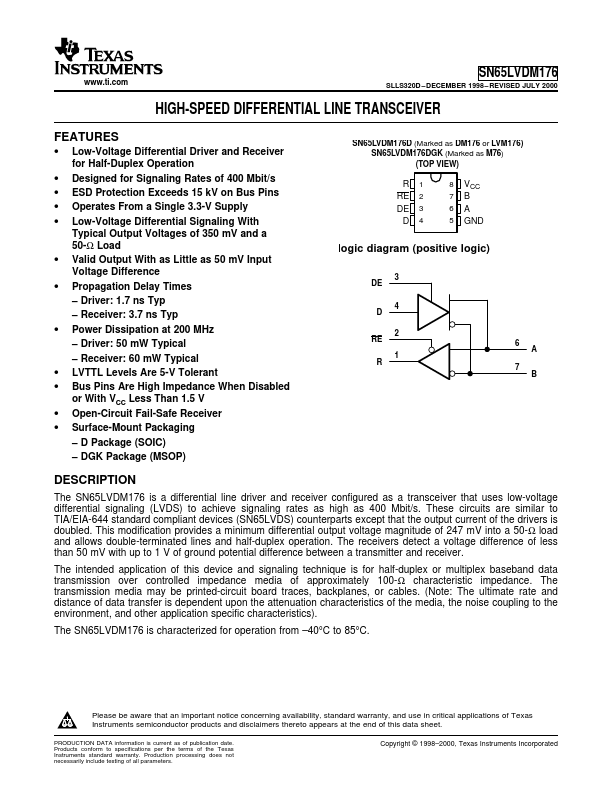
SN65LVDM176D (Marked as DM176 or LVM176) SN65LVDM176DGK (Marked as M76) (TOP VIEW)
R1 RE 2 DE 3
D4
8 VCC 7B 6A 5 GND logic diagram (positive logic)
3 DE
4 D
2 RE
1 R
6 A
7 B
DESCRIPTION
The SN65LVDM176 is a differential line driver and receiver configured as a transceiver that uses low-voltage differential signaling (LVDS) to achieve signaling rates as high as 400 Mbit/s. These circuits are similar to TIA/EIA-644 standard pliant devices (SN65LVDS) counterparts except that the output current of the drivers is doubled. This modification provides a minimum differential output voltage magnitude of 247 m V into a 50-Ω load and allows double-terminated lines and half-duplex operation. The receivers detect a voltage difference of less than 50 m V with up to 1 V of ground potential difference between a transmitter and receiver.
The intended application of this device and signaling technique is for half-duplex or multiplex baseband data transmission over controlled impedance media of approximately 100-Ω characteristic impedance. The transmission media may be printed-circuit board traces, backplanes, or cables. (Note: The ultimate rate and distance of data transfer is dependent upon the attenuation characteristics of the media, the noise coupling to the...