SN74BCT543
SN74BCT543 is Octal Registered Transceivers manufactured by Texas Instruments.
SN54BCT543, SN74BCT543 OCTAL REGISTERED TRANSCEIVERS
WITH 3ĆSTATE OUTPUTS
SCBS026C
- NOVEMBER 1988
- REVISED APRIL 1994
- State-of-the-Art Bi CMOS Design
Significantly Reduces ICCZ
- 3-State True Outputs
- Back-to-Back Registers for Storage
- ESD Protection Exceeds 2000 V
Per MIL-STD-883C, Method 3015
- Package Options Include Plastic
Small-Outline Packages (DW), Ceramic Chip Carriers (FK) and Flatpacks (W), and Plastic and Ceramic 300-mil DIPs (JT, NT) description
The ′BCT543 octal transceiver contains two sets of D-type latches for temporary storage of data flowing in either direction. Separate latch-enable (LEAB or LEBA) and output-enable (OEAB or OEBA) inputs are provided for each register to permit independent control in either direction of data flow.
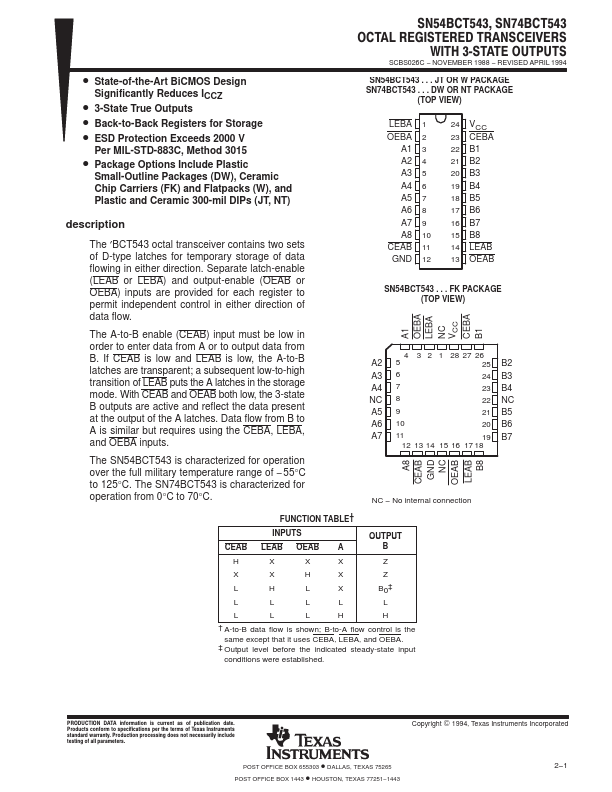
SN54BCT543 . . . JT OR W PACKAGE SN74BCT543 . . . DW OR NT PACKAGE
(TOP VIEW)
LEBA 1 OEBA 2
A1 3 A2 4 A3 5 A4 6 A5 7 A6 8 A7 9 A8 10 CEAB 11 GND 12
24 VCC 23 CEBA 22 B1 21 B2 20 B3 19 B4 18 B5 17 B6 16 B7 15 B8 14 LEAB 13 OEAB
SN54BCT543 . . . FK PACKAGE (TOP VIEW)
A1 OEBA LEBA NC VCC CEBA B1
The A-to-B enable (CEAB) input must be low in order to enter data from A or to output data from B. If CEAB is low and LEAB is low, the A-to-B latches are transparent; a subsequent low-to-high transition of LEAB puts the A latches in the storage mode. With CEAB and OEAB both low, the 3-state B outputs are active and reflect the data present at the output of the A latches. Data flow from B to A is similar but requires using the CEBA, LEBA, and OEBA inputs.
The SN54BCT543 is characterized for operation over the full military temperature range of
- 55°C to 125°C. The SN74BCT543 is characterized for operation from 0°C to 70°C.
4 3 2 1 28 27 26
A2 5
25 B2
A3 6
24 B3
A4...