SN74CB3Q16244
SN74CB3Q16244 is 16-Bit FET Bus Switch manufactured by Texas Instruments.
Features
- 1 High-Bandwidth Data Path (Up to 500 MHz)(1)
- 5-V Tolerant I/Os With Device Powered Up or Powered Down
- Low and Flat ON-State Resistance (ron) Characteristics Over Operating Range (ron= 5 Ω Typical)
- Rail-to-Rail Switching on Data I/O Ports
- 0 to 5-V Switching With 3.3-V VCC
- 0 to 3.3-V Switching With 2.5-V VCC
- Bidirectional Data Flow With Near-Zero Propagation Delay
- Low Input and Output Capacitance Minimizes Loading and Signal Distortion (Cio(OFF) = 4 p F Typical)
- Fast Switching Frequency (f OE = 20 MHz Maximum)
- Data and Control Inputs Provide Undershoot Clamp Diodes
- Low Power Consumption (ICC = 1 m A Typical)
- VCC Operating Range From 2.3 V to 3.6 V
- Data I/Os Support 0 to 5-V Signaling Levels
(0.8 V, 1.2 V, 1.5 V, 1.8 V, 2.5 V, 3.3 V, 5 V)
- Control Inputs Can Be Driven by TTL or 5-V and 3.3-V CMOS Outputs
- Ioff Supports Partial-Power-Down Mode Operation
- Latch-Up Performance Exceeds 100 m A
Per JESD 78, Class II
- ESD Performance Tested Per JESD 22
- 2000-V Human Body Model (A114-B, Class II)
- 1000-V Charged-Device Model (C101)
- Supports Both Digital and Analog Applications
(1) For additional information regarding the performance characteristics of the CB3Q family, refer to the TI application report CBT-C, CB3T, and CB3Q Signal-Switch Families, (SCDA008).
2 Applications
- IP Phones: Wired and Wireless
- Optical Modules
- Optical Networking: Video Over Fiber and EPON
- Private Branch Exchange (PBX)
- Wi MAX and Wireless Infrastructure Equipment
3 Description
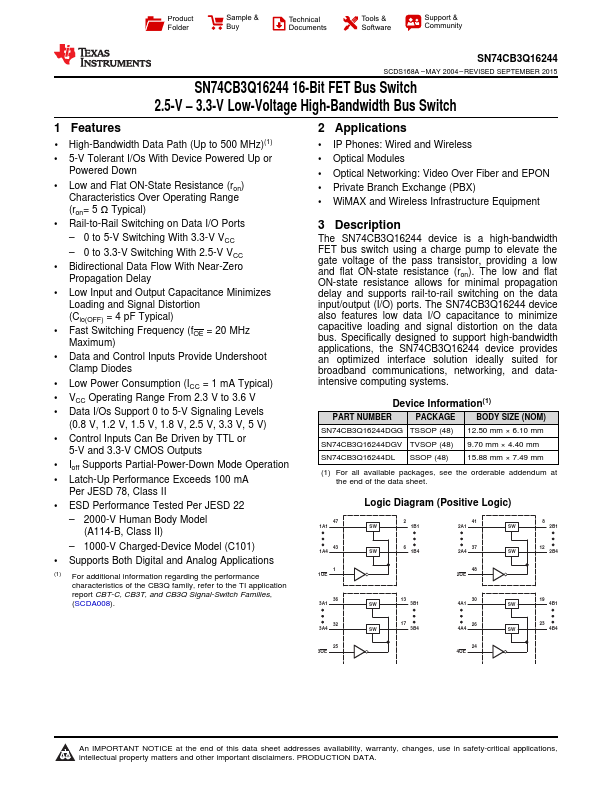
The SN74CB3Q16244 device is a high-bandwidth FET bus switch using a charge pump to elevate the gate voltage of the pass transistor, providing a low and flat ON-state resistance (ron). The low and flat ON-state resistance allows for minimal propagation delay and supports rail-to-rail switching on the data input/output (I/O) ports. The SN74CB3Q16244 device also features low data I/O capacitance to minimize capacitive loading and signal distortion on the data bus. Specifically...