• Part: SN74CB3T1G125
  • Description: 2.5-V/3.3-V LOW-VOLTAGE SWITCH
  • Manufacturer: Texas Instruments
  • Size: 613.42 KB
Download SN74CB3T1G125 Datasheet PDF
Texas Instruments
SN74CB3T1G125
SN74CB3T1G125 is 2.5-V/3.3-V LOW-VOLTAGE SWITCH manufactured by Texas Instruments.
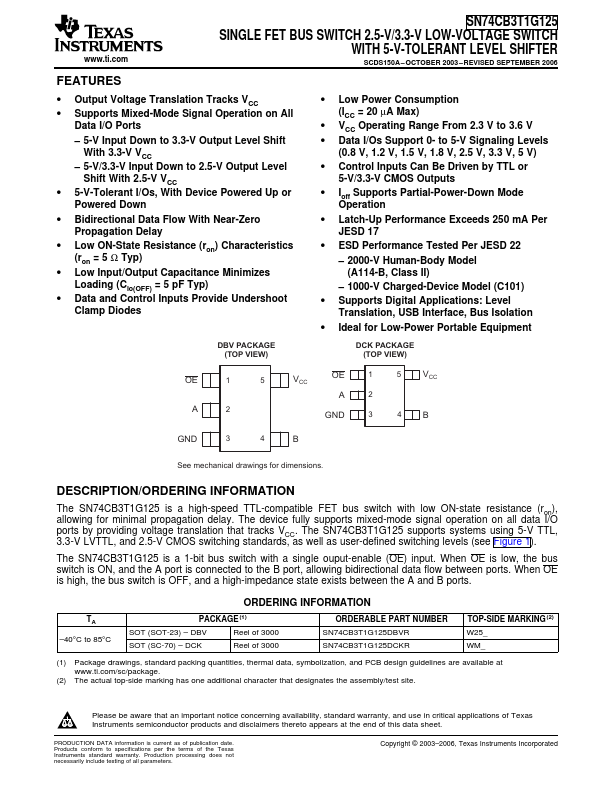
FEATURES - Output Voltage Translation Tracks VCC - Supports Mixed-Mode Signal Operation on All Data I/O Ports - 5-V Input Down to 3.3-V Output Level Shift With 3.3-V VCC - 5-V/3.3-V Input Down to 2.5-V Output Level Shift With 2.5-V VCC - 5-V-Tolerant I/Os, With Device Powered Up or Powered Down - Bidirectional Data Flow With Near-Zero Propagation Delay - Low ON-State Resistance (ron) Characteristics (ron = 5 Ω Typ) - Low Input/Output Capacitance Minimizes Loading (Cio(OFF) = 5 p F Typ) - Data and Control Inputs Provide Undershoot Clamp Diodes - Low Power Consumption (ICC = 20 µA Max) - VCC Operating Range From 2.3 V to 3.6 V - Data I/Os Support 0- to 5-V Signaling Levels (0.8 V, 1.2 V, 1.5 V, 1.8 V, 2.5 V, 3.3 V, 5 V) - Control Inputs Can Be Driven by TTL or 5-V/3.3-V CMOS Outputs - Ioff Supports Partial-Power-Down Mode Operation - Latch-Up Performance Exceeds 250 m A Per JESD 17 - ESD Performance Tested Per JESD 22 - 2000-V Human-Body Model (A114-B, Class II) - 1000-V Charged-Device Model (C101) - Supports Digital Applications: Level Translation, USB Interface, Bus Isolation - Ideal for Low-Power Portable Equipment DBV PACKAGE (TOP VIEW) DCK PACKAGE (TOP VIEW) 4B See mechanical drawings for dimensions. DESCRIPTION /ORDERING INFORMATION The SN74CB3T1G125 is a high-speed TTL-patible FET bus switch with low ON-state resistance (ron), allowing for minimal propagation delay. The device fully supports mixed-mode signal operation on all data I/O ports by providing voltage translation that tracks VCC. The SN74CB3T1G125 supports systems using 5-V TTL, 3.3-V LVTTL, and 2.5-V CMOS switching standards, as well as user-defined switching levels (see Figure 1). The SN74CB3T1G125 is a 1-bit bus switch with a single ouput-enable (OE) input. When OE is low, the bus switch is ON, and the A port is connected to the B port, allowing bidirectional data flow between ports. When OE is high, the bus switch is OFF, and a...