SN74LVC543A
SN74LVC543A is OCTAL REGISTERED TRANSCEIVER manufactured by Texas Instruments.
FEATURES
- Operates From 1.65 V to 3.6 V
- Inputs Accept Voltages to 5.5 V
- Max tpd of 7 ns at 3.3 V
- Typical VOLP (Output Ground Bounce)
<0.8 V at VCC = 3.3 V, TA = 25°C
- Typical VOHV (Output VOH Undershoot)
>2 V at VCC = 3.3 V, TA = 25°C
- Supports Mixed-Mode Signal Operation on All
Ports (5-V Input/Output Voltage With 3.3-V VCC)
- Ioff Supports Partial-Power-Down Mode Operation
- Latch-Up Performance Exceeds 250 m A Per JESD 17
SN74LVC543A OCTAL REGISTERED TRANSCEIVER
WITH 3-STATE OUTPUTS
SCAS299H
- JANUARY 1993
- REVISED MARCH 2005
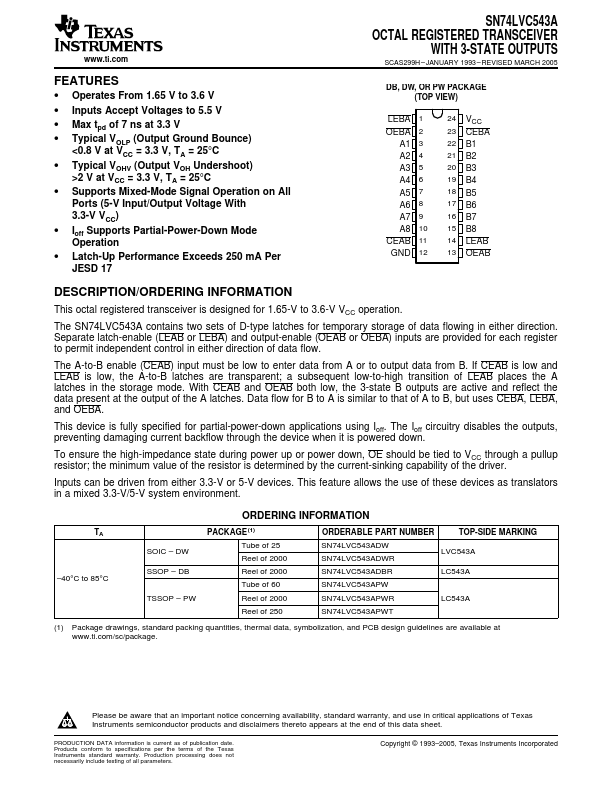
DB, DW, OR PW PACKAGE (TOP VIEW)
LEBA 1 OEBA 2
A1 3 A2 4 A3 5 A4 6 A5 7 A6 8 A7 9 A8 10 CEAB 11 GND 12
24 VCC 23 CEBA 22 B1 21 B2 20 B3 19 B4 18 B5 17 B6 16 B7 15 B8 14 LEAB 13 OEAB
DESCRIPTION
/ORDERING INFORMATION
This octal registered transceiver is designed for 1.65-V to 3.6-V VCC operation.
The SN74LVC543A contains two sets of D-type latches for temporary storage of data flowing in either direction. Separate latch-enable (LEAB or LEBA) and output-enable (OEAB or OEBA) inputs are provided for each register to permit independent control in either direction of data flow.
The A-to-B enable (CEAB) input must be low to enter data from A or to output data from B. If CEAB is low and LEAB is low, the A-to-B latches are transparent; a subsequent low-to-high transition of LEAB places the A latches in the storage mode. With CEAB and OEAB both low, the 3-state B outputs are active and reflect the data present at the output of the A latches. Data flow for B to A is similar to that of A to B, but uses CEBA, LEBA, and OEBA.
This device is fully specified for partial-power-down applications using Ioff. The Ioff circuitry disables the outputs, preventing damaging current backflow through the device when it is powered down.
To ensure the high-impedance state during power up or power down, OE should be tied to VCC through a pullup resistor; the minimum value of the resistor is determined by the current-sinking capability of the driver.
Inputs...