• Part: SN74LVTH245A-EP
  • Description: 3.3-V ABT OCTAL BUS TRANSCEIVERS
  • Manufacturer: Texas Instruments
  • Size: 495.27 KB
Download SN74LVTH245A-EP Datasheet PDF
Texas Instruments
SN74LVTH245A-EP
SN74LVTH245A-EP is 3.3-V ABT OCTAL BUS TRANSCEIVERS manufactured by Texas Instruments.
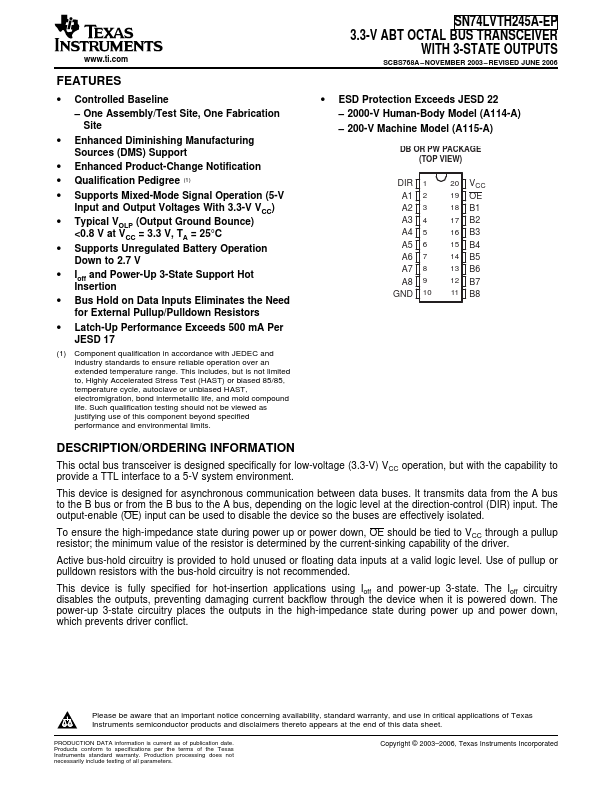
FEATURES - Controlled Baseline - One Assembly/Test Site, One Fabrication Site - Enhanced Diminishing Manufacturing Sources (DMS) Support - Enhanced Product-Change Notification - Qualification Pedigree (1) - Supports Mixed-Mode Signal Operation (5-V Input and Output Voltages With 3.3-V VCC) - Typical VOLP (Output Ground Bounce) <0.8 V at VCC = 3.3 V, TA = 25°C - Supports Unregulated Battery Operation Down to 2.7 V - Ioff and Power-Up 3-State Support Hot Insertion - Bus Hold on Data Inputs Eliminates the Need for External Pullup/Pulldown Resistors - Latch-Up Performance Exceeds 500 m A Per JESD 17 (1) ponent qualification in accordance with JEDEC and industry standards to ensure reliable operation over an extended temperature range. This includes, but is not limited to, Highly Accelerated Stress Test (HAST) or biased 85/85, temperature cycle, autoclave or unbiased HAST, electromigration, bond intermetallic life, and mold pound life. Such qualification testing should not be viewed as justifying use of this ponent beyond specified performance and environmental limits. SN74LVTH245A-EP 3.3-V ABT OCTAL BUS TRANSCEIVER WITH 3-STATE OUTPUTS SCBS768A - NOVEMBER 2003 - REVISED JUNE 2006 - ESD Protection Exceeds JESD 22 - 2000-V Human-Body Model (A114-A) - 200-V Machine Model (A115-A) DB OR PW PACKAGE (TOP VIEW) DIR 1 A1 2 A2 3 A3 4 A4 5 A5 6 A6 7 A7 8 A8 9 GND 10 20 VCC 19 OE 18 B1 17 B2 16 B3 15 B4 14 B5 13 B6 12 B7 11 B8 DESCRIPTION /ORDERING INFORMATION This octal bus transceiver is designed specifically for low-voltage (3.3-V) VCC operation, but with the capability to provide a TTL interface to a 5-V system environment. This device is designed for asynchronous munication between data buses. It transmits data from the A bus to the B bus or from the B bus to the A bus, depending on the logic level at the direction-control (DIR) input. The output-enable (OE) input can be used to disable the device so the buses are effectively isolated. To ensure the high-impedance state...