SN75176AP
SN75176AP is Differential Bus Transceiver manufactured by Texas Instruments.
- Part of the SN75176A comparator family.
Features
- Bidirectional Transceiver
- Meets or Exceeds the Requirements of
ANSI Standards EIA/TIA-422-B and ITU Remendations V.11
- Designed for Multipoint Transmission on Long Bus Lines in Noisy Environments
- 3-State Driver and Receiver Outputs
- Individual Driver and Receiver Enables
- Wide Positive and Negative Input/Output Bus Voltage Ranges
- Driver Output Capability ±60 m A Max
- Thermal-Shutdown Protection
- Driver Positive-Current Limiting and Negative Current Limiting
- Receiver Input Impedance 12 kΩ Min
- Receiver Input Sensitivity ±200 m V
- Receiver Input Hysteresis 50 m V Typ
- Operates From Single 5-V Supply
- Lower Power Requirements
2 Applications
- Low Speed RS485 munication (5 Mbps or less)
- For 10 Mbps, use SN75176B
3 Description
The SN75176A differential bus transceiver is a monolithic integrated circuit designed for bidirectional data munication on multipoint bus-transmission lines. It is designed for balanced transmission lines and meets ANSI Standard EIA/TIA-422-B and ITU Remendation V.11.
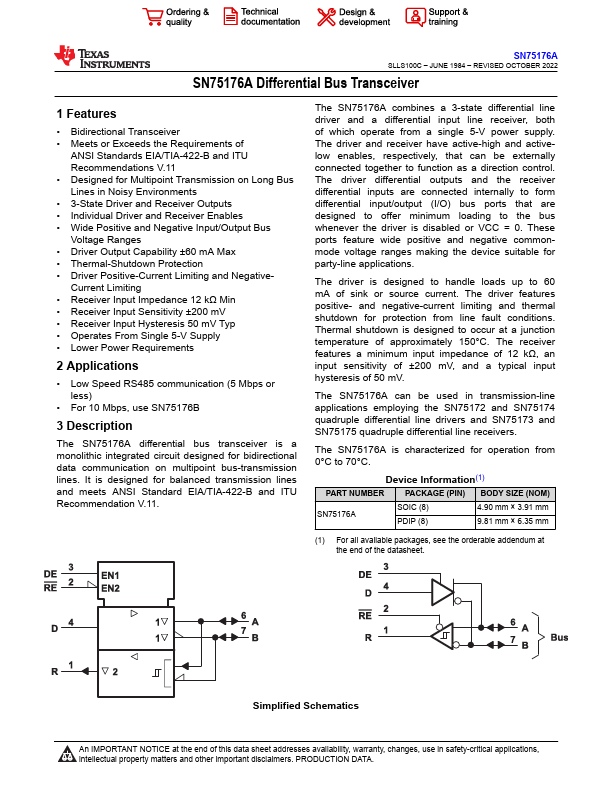
The SN75176A bines a 3-state differential line driver and a differential input line receiver, both of which operate from a single 5-V power supply. The driver and receiver have active-high and activelow enables, respectively, that can be externally connected together to function as a direction control. The driver differential outputs and the receiver differential inputs are connected internally to form differential input/output (I/O) bus ports that are designed to offer minimum loading to the bus whenever the driver is disabled or VCC = 0. These ports feature wide positive and negative monmode voltage ranges making the device suitable for party-line applications.
The driver is designed to handle loads up to 60 m A of sink or source current. The driver features positive- and negative-current limiting and thermal shutdown for protection from line fault conditions. Thermal shutdown is designed to occur at a junction temperature of approximately 150°C. The...