TL851
TL851 is SONAR RANGING CONTROLLER manufactured by Texas Instruments.
TL851 SONAR RANGING CONTROL
D Designed for Use With the TL852 in Sonar
Ranging Modules Like the SN28827
D Operates With Single Supply D Accurate Clock Output for External Use D Synchronous 4-Bit Gain Control Output D Internal 1.2-V Level Detector for Receive D TTL-patible D Interfaces to Electrostatic or Piezoelectric
Transducers description
SLSS004
- SEPTEMBER 1983
- REVISED MARCH 1988
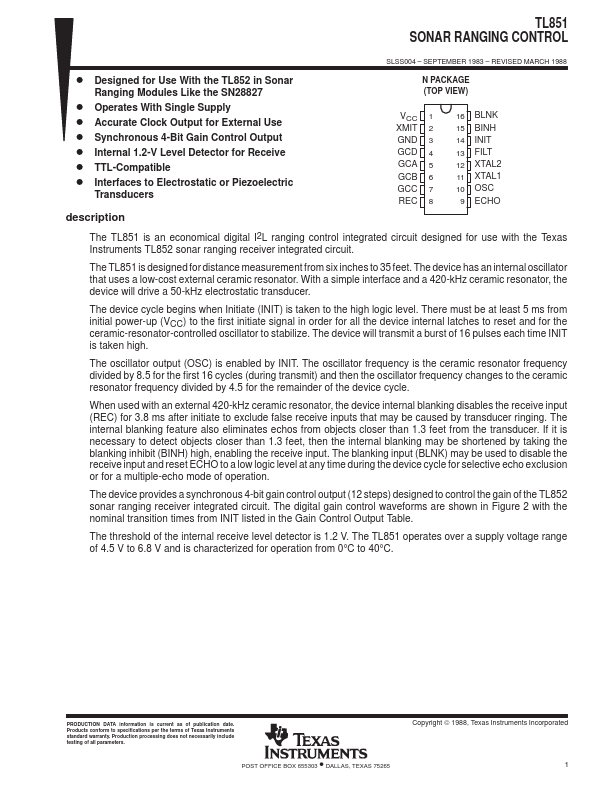
N PACKAGE (TOP VIEW)
VCC 1 XMIT 2 GND 3 GCD 4 GCA 5 GCB 6 GCC 7 REC 8
16 BLNK 15 BINH 14 INIT 13 FILT 12 XTAL2 11 XTAL1 10 OSC 9 ECHO
The TL851 is an economical digital I2L ranging control integrated circuit designed for use with the Texas Instruments TL852 sonar ranging receiver integrated circuit.
The TL851 is designed for distance measurement from six inches to 35 feet. The device has an internal oscillator that uses a low-cost external ceramic resonator. With a simple interface and a 420-k Hz ceramic resonator, the device will drive a 50-k Hz electrostatic transducer.
The device cycle begins when Initiate (INIT) is taken to the high logic level. There must be at least 5 ms from initial power-up (VCC) to the first initiate signal in order for all the device internal latches to reset and for the ceramic-resonator-controlled oscillator to stabilize. The device will transmit a burst of 16 pulses each time INIT is taken high.
The oscillator output (OSC) is enabled by INIT. The oscillator frequency is the ceramic resonator frequency divided by 8.5 for the first 16 cycles (during transmit) and then the oscillator frequency changes to the ceramic resonator frequency divided by 4.5 for the remainder of the device cycle.
When used with an external 420-k Hz ceramic resonator, the device internal blanking disables the receive input (REC) for 3.8 ms after initiate to exclude false receive inputs that may be caused by transducer ringing. The internal blanking feature also eliminates echos from objects closer than 1.3 feet from the transducer. If it is necessary to detect objects...