TLC2252-EP
TLC2252-EP is RAIL-TO-RAIL VERY LOW-POWER OPERATIONAL AMPLIFIERS manufactured by Texas Instruments.
ą TLC225xĆEP, TLC225x AĆEP Advanced Lin CMOS RAILĆTOĆRAIL
VERY LOWĆPOWER OPERATIONAL AMPLIFIERS SGLS216
- NOVEMBER 2003
D Controlled Baseline
- One Assembly/Test Site, One Fabrication Site
D Extended Temperature Performance of
- 40°C to 125°C
D Enhanced Diminishing Manufacturing
Sources (DMS) Support
D Enhanced Product-Change Notification D Qualification Pedigree† D ESD Protection Exceeds 2000 V Per
MIL-STD-883, Method 3015; Exceeds 150 V (TLC2252/52A) and 100 V (TLC2254/54A) Using Machine Model (C = 200 p F, R = 0)
† ponent qualification in accordance with JEDEC and industry standards to ensure reliable operation over an extended temperature range. This includes, but is not limited to, Highly Accelerated Stress Test (HAST) or biased 85/85, temperature cycle, autoclave or unbiased HAST, electromigration, bond intermetallic life, and mold pound life. Such qualification testing should not be viewed as justifying use of this ponent beyond specified performance and environmental limits.
D Output Swing Includes Both Supply Rails D Low Noise . . . 19 n V/√Hz Typ at f = 1 k Hz D Low Input Bias Current . . . 1 p A Typ D Fully Specified for Both Single-Supply and
Split-Supply Operation
D Very Low Power . . . 35 µA Per Channel Typ D mon-Mode Input Voltage Range
Includes Negative Rail
D Low Input Offset Voltage
850 µV Max at TA = 25°C (TLC225x A)
D Macromodel Included D Performance Upgrades for the TS27L2/L4 and TLC27L2/L4
VVNn
- Equivalent Input Noise Voltage
- nnv V///Hz Hz description
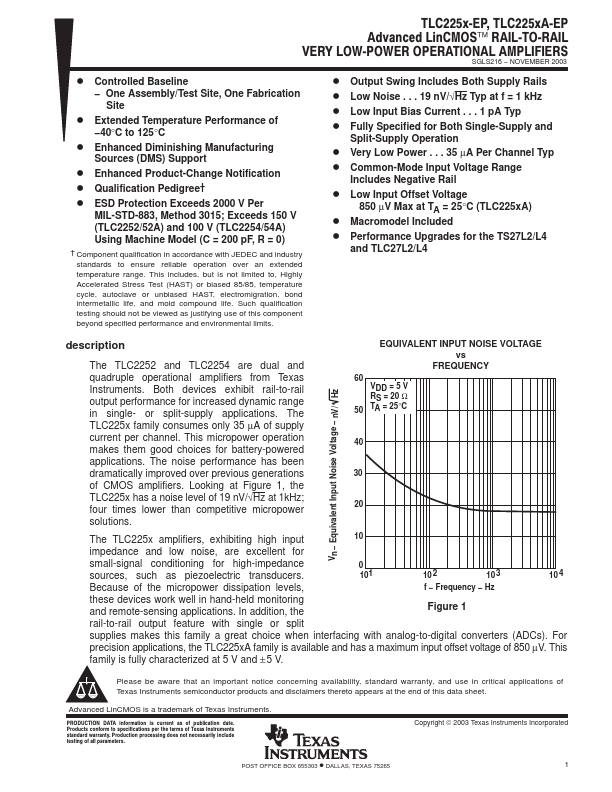
The TLC2252 and TLC2254 are dual and quadruple operational amplifiers from Texas Instruments. Both devices exhibit rail-to-rail output performance for increased dynamic range in single- or split-supply applications. The TLC225x family consumes only 35 µA of supply current per channel. This micropower operation makes them good choices for battery-powered applications. The noise performance has been dramatically improved over previous generations of CMOS amplifiers. Looking at Figure 1,...