TMAG5253
TMAG5253 is Low-Power Linear Hall Effect Sensor manufactured by Texas Instruments.
Features
- Industry-leading low power:
- Supply voltage, VCC: 1.65 V
- 3.6 V
- Shutdown current: < 20 n A (1.8 V at 25°C)
- Active current: 2 m A (1.8 V at 25°C)
- Average current: <10 µA at 100-Hz duty cycling
- Dedicated enable pin
- Fast power-on time: < 25 µs
- Ratiometric analog output proportional to VCC
- High impedance output during shutdown mode
- Low-noise output with ±1-m A drive
- Bipolar sensitivity option to support both positive and negative magnetic fields
- Magnetic sensitivity range options:
- A1: ±20-m T Range
- A2: ±40-m T Range
- A3: ±80-m T Range
- A4: ±160-m T Range
- Sensitivity pensation to support temperature drift of Neodymium magnet
- Ultra-small X2SON 4-pin package: 1.54 mm2
- Wide operating temperature range:
- 40°C to 125°C
2 Applications
- Gaming controller & peripherals
- Magnetic proximity sensor
- Mobile robot motor control
- Cordless power tools
- Vacuum robots
- Drone payload control
Supply Voltage
3 Description
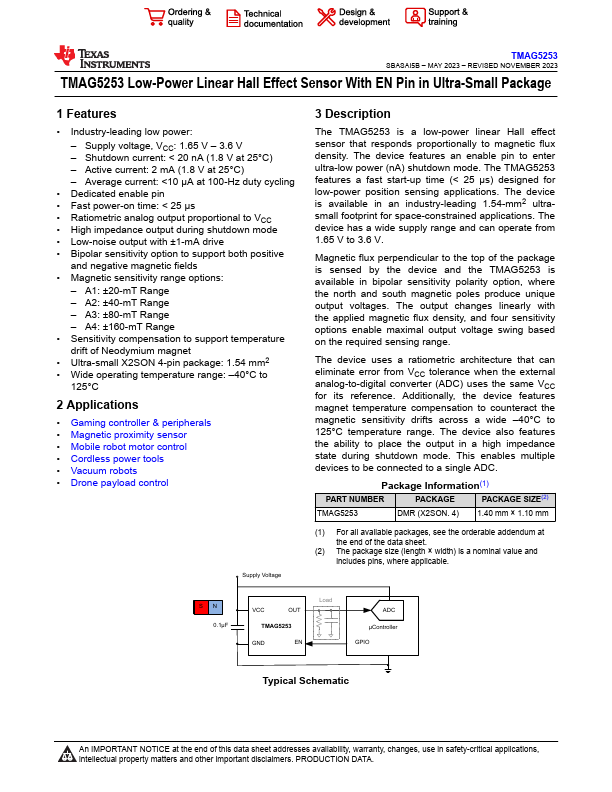
The TMAG5253 is a low-power linear Hall effect sensor that responds proportionally to magnetic flux density. The device features an enable pin to enter ultra-low power (n A) shutdown mode. The TMAG5253 features a fast start-up time (< 25 µs) designed for low-power position sensing applications. The device is available in an industry-leading 1.54-mm2 ultrasmall footprint for space-constrained applications. The device has a wide supply range and can operate from 1.65 V to 3.6 V.
Magnetic flux perpendicular to the top of the package is sensed by the device and the TMAG5253 is available in bipolar sensitivity polarity option, where the north and south magnetic poles produce unique output voltages. The output changes linearly with the applied magnetic flux density, and four sensitivity options enable maximal output voltage swing based on the required sensing range.
The device uses a ratiometric architecture that can eliminate error from VCC tolerance when the external analog-to-digital converter (ADC) uses the same VCC for its...