TPS54622
TPS54622 is 6-A Synchronous Step-Down Converter manufactured by Texas Instruments.
Features
- 1 Integrated 26-mΩ and 19-mΩ MOSFETs
- Split Power Rail: 1.6 V to 17 V on PVIN
- 200-k Hz to 1.6-MHz Switching Frequency
- Synchronizes to External Clock
- 0.6V ±1% Voltage Reference Overtemperature
- Hiccup Current Limit
- Monotonic Start-Up Into Prebiased Outputs
- - 40°C to 150°C Operating Junction Temperature
Range
- Adjustable Slow Start and Power Sequencing
- Power Good Output Monitor for Undervoltage and
Overvoltage
- Adjustable Input Undervoltage Lockout
- For SWIFT™ Documentation, visit http://.ti./swift
- Create a Custom Design Using the TPS54622
With the WEBENCH® Power Designer
2 Applications
- High-Density Distributed Power Systems
- High-Performance Point-of-Load Regulation
- Broadband, Networking, and Optical munications Infrastructure
R3 CSS RRT C1
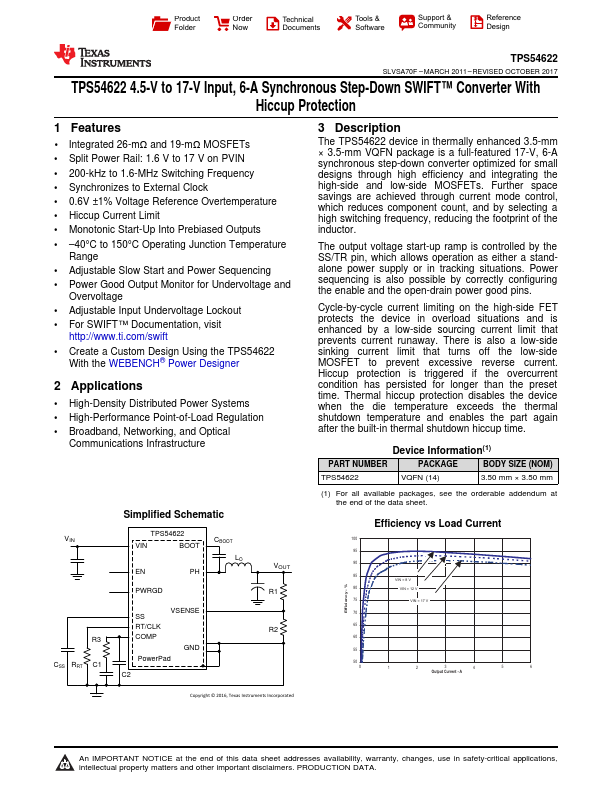
Simplified Schematic
BOOT
CBOOT LO
PWRGD
SS RT/CLK P
VSENSE
Power Pad
C2
VOUT R1
R2
3 Description
The TPS54622 device in thermally enhanced 3.5-mm × 3.5-mm VQFN package is a full-featured 17-V, 6-A synchronous step-down converter optimized for small designs through high efficiency and integrating the high-side and low-side MOSFETs. Further space savings are achieved through current mode control, which reduces ponent count, and by selecting a high switching frequency, reducing the footprint of the inductor.
The output voltage start-up ramp is controlled by the SS/TR pin, which allows operation as either a standalone power supply or in tracking situations. Power sequencing is also possible by correctly configuring the enable and the open-drain power good pins.
Cycle-by-cycle current limiting on the high-side FET protects the device in overload situations and is enhanced by a low-side sourcing current limit that prevents current runaway. There is also a low-side sinking current limit that turns off the low-side MOSFET to prevent excessive reverse current. Hiccup protection is triggered if the overcurrent condition has persisted for longer than the preset time....