TPS56221
TPS56221 is Synchronous Buck SWIFT Converter manufactured by Texas Instruments.
Features
- 1 4.5-V to 14-V Input Voltage Range
- Incorporates Power Block Technology
- Up to 25-A Output Current
- Fixed-Frequency Options of 300 k Hz, 500 k Hz, and 1 MHz
- High-Side and Low-Side MOSFET RDS(on) Sensing
- Programmable Soft-Start
- 600-m V Reference Voltage With 1% Accuracy
- Voltage Mode Control with Feed-Forward
- Supports Prebiased Output
- Thermal Shutdown
- 22-Pin 5-mm × 6-mm PQFN Power PAD™
Package
- For SWIFT™ Power Products Documentation, see http://.ti./swift
2 Applications
- Point-of-Load (POL) Power Modules
- High-Density DC-DC Converters for Tele and
Networking Applications
3 Description
The TPS56221 device is a high-efficiency and highcurrent synchronous buck converter designed to operate from a supply from 4.5 V to 14 V. The device can produce an output voltage as low as 0.6 V at loads up to 25 A. Integrated Nex FET™ Power MOSFETs provide a small footprint and ease of use.
The device implements a voltage-mode control with voltage feed-forward pensation that responds instantly to input voltage change.
The TPS56221 is available in a thermally enhanced 22-pin PQFN (DQP) Power PAD package.
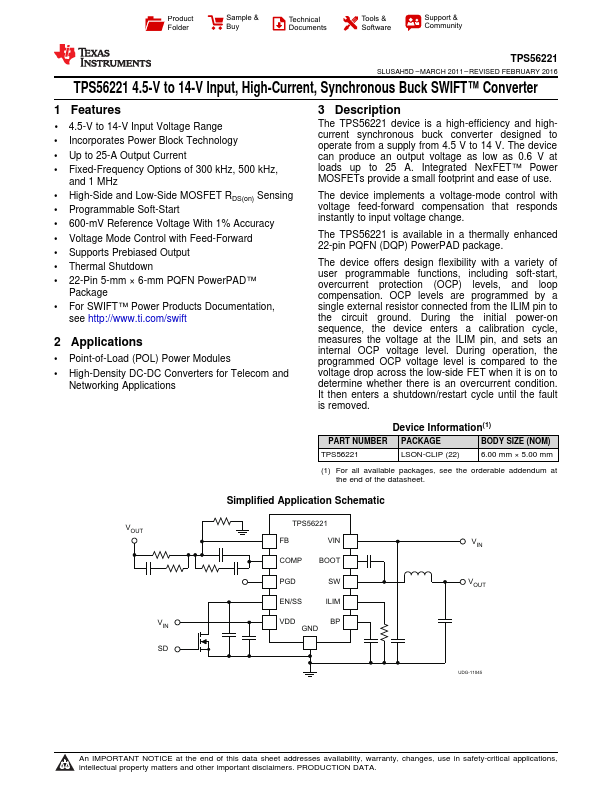
The device offers design flexibility with a variety of user programmable functions, including soft-start, overcurrent protection (OCP) levels, and loop pensation. OCP levels are programmed by a single external resistor connected from the ILIM pin to the circuit ground. During the initial power-on sequence, the device enters a calibration cycle, measures the voltage at the ILIM pin, and sets an internal OCP voltage level. During operation, the programmed OCP voltage level is pared to the voltage drop across the low-side FET when it is on to determine whether there is an overcurrent condition. It then enters a shutdown/restart cycle until the fault is removed.
Device Information(1)
PART NUMBER PACKAGE
BODY SIZE (NOM)
LSON-CLIP (22)
6.00 mm × 5.00 mm
(1) For all available packages, see the orderable addendum at the end of the datasheet.
Simplified...