Datasheet4U Logo Datasheet4U.com

TPS92074D - Buck PFC LED Driver

This page provides the datasheet information for the TPS92074D, a member of the TPS92074 Buck PFC LED Driver family.

Datasheet Summary

Description

The TPS92074 is a hybrid power factor controller (PFC) optimized for driving LED lighting solutions that do not require phase dimming compatibility.

The device monitors the converter rectified AC waveform using an internal, low-power, digital controller.

Features

  • 1.
  • Controlled Reference Derived PFC.
  • Digital 50/60 Hz Synchronization.
  • Constant LED current operation.
  • Single Winding Magnetic Configurations.
  • Low Typical Operating Current.
  • Fast Start-up.
  • Overvoltage Protection.
  • Feedback Short-Circuit Protection.
  • Wide Temperature Operation Range.
  • Low BOM Cost and Small PCB Footprint.
  • Patent Pending Digital Architecture.
  • 8-Pin SOIC and 6-Pin TSOT Available.

📥 Download Datasheet

Datasheet preview – TPS92074D

Datasheet Details

Part number TPS92074D
Manufacturer Texas Instruments
File Size 1.06 MB
Description Buck PFC LED Driver
Datasheet download datasheet TPS92074D Datasheet
Additional preview pages of the TPS92074D datasheet.
Other Datasheets by Texas Instruments

Full PDF Text Transcription

Click to expand full text
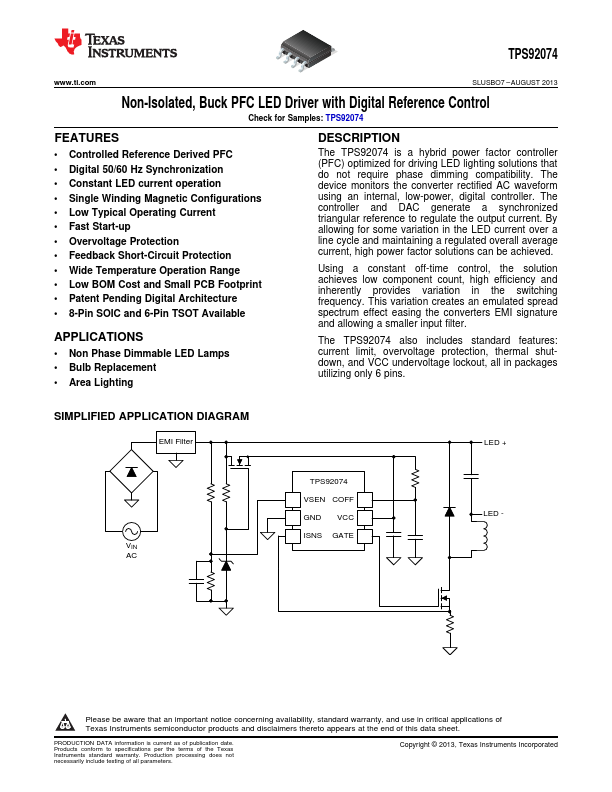
TPS92074 www.ti.com SLUSBO7 – AUGUST 2013 Non-Isolated, Buck PFC LED Driver with Digital Reference Control Check for Samples: TPS92074 FEATURES 1 • Controlled Reference Derived PFC • Digital 50/60 Hz Synchronization • Constant LED current operation • Single Winding Magnetic Configurations • Low Typical Operating Current • Fast Start-up • Overvoltage Protection • Feedback Short-Circuit Protection • Wide Temperature Operation Range • Low BOM Cost and Small PCB Footprint • Patent Pending Digital Architecture • 8-Pin SOIC and 6-Pin TSOT Available APPLICATIONS • Non Phase Dimmable LED Lamps • Bulb Replacement • Area Lighting DESCRIPTION The TPS92074 is a hybrid power factor controller (PFC) optimized for driving LED lighting solutions that do not require phase dimming compatibility.
Published: |