bq27500
bq27500 is System-Side Impedance Track Fuel Gauge manufactured by Texas Instruments.
FEATURES
- Battery Fuel Gauge for 1-Series Li-Ion Applications
- Resides on System Main Board
- Works With Embedded or Removable Battery Packs
- Two Varieties
- bq27500: Uses PACK+, PACK- , and T Battery Terminals
- bq27501: Works With Battery ID Resistor in Battery Pack
- Microcontroller Peripheral Provides:
- Accurate Battery Fuel Gauging
- Internal Temperature Sensor for System Temperature Reporting
- Battery Low Interrupt Warning
- Battery Insertion Indicator
- Battery ID Detection
- 96 Bytes of Non-Volatile Scratch-Pad FLASH
- Battery Fuel Gauge Based on Patented Impedance Track™ Technology
- Models the Battery Discharge Curve for Accurate Time-to-Empty Predictions
- Automatically Adjusts for Battery Aging, Battery Self-Discharge, and Temperature/Rate Inefficiencies
- Low-Value Sense Resistor (10 mΩ or Less)
- I2C™ Interface for Connection to System Microcontroller Port
- 12-Pin 2,5-mm × 4-mm SON Package
1.2 APPLICATIONS
- Smartphones
- PDAs
- Digital Still and Video Cameras
- Handheld Terminals
- MP3 or Multimedia Players
1.3 DESCRIPTION
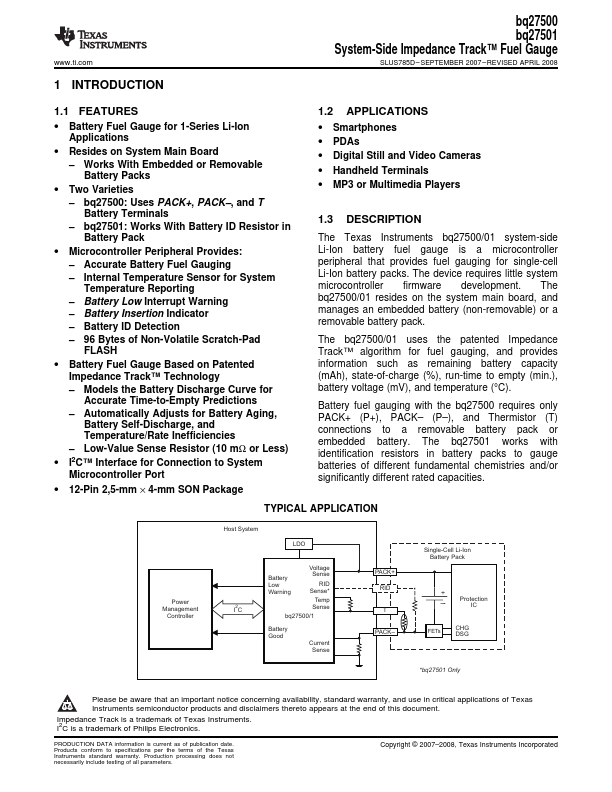
The Texas Instruments bq27500/01 system-side Li-Ion battery fuel gauge is a microcontroller peripheral that provides fuel gauging for single-cell Li-Ion battery packs. The device requires little system microcontroller firmware development. The bq27500/01 resides on the system main board, and manages an embedded battery (non-removable) or a removable battery pack.
The bq27500/01 uses the patented Impedance Track™ algorithm for fuel gauging, and provides information such as remaining battery capacity (m Ah), state-of-charge (%), run-time to empty (min.), battery voltage (m V), and temperature (°C).
Battery fuel gauging with the bq27500 requires only PACK+ (P+), PACK- (P- ), and Thermistor (T) connections to a removable battery pack or embedded battery. The bq27501 works with identification resistors in battery packs to gauge batteries of different fundamental chemistries and/or significantly different rated capacities.
TYPICAL...