Datasheet4U Logo Datasheet4U.com

74HC4053D - Triple 2-channel analog multiplexer/demultiplexer

Download the 74HC4053D datasheet PDF. This datasheet also covers the 74HC4053 variant, as both devices belong to the same triple 2-channel analog multiplexer/demultiplexer family and are provided as variant models within a single manufacturer datasheet.

General Description

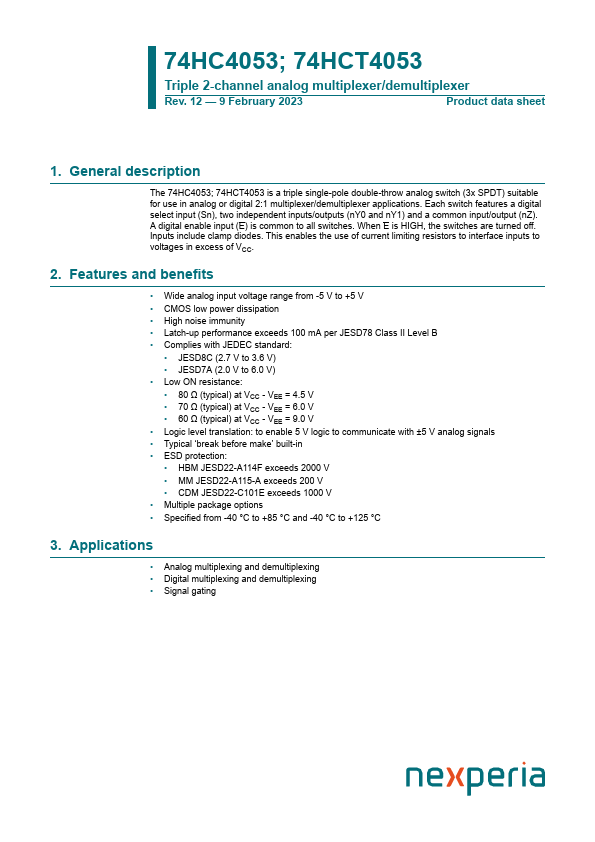
The 74HC4053; 74HCT4053 is a triple single-pole double-throw analog switch (3x SPDT) suitable for use in analog or digital 2:1 multiplexer/demultiplexer applications.

Key Features

  • Wide analog input voltage range from -5 V to +5 V.
  • CMOS low power dissipation.
  • High noise immunity.
  • Latch-up performance exceeds 100 mA per JESD78 Class II Level B.
  • Complies with JEDEC standard:.
  • JESD8C (2.7 V to 3.6 V).
  • JESD7A (2.0 V to 6.0 V).
  • Low ON resistance:.
  • 80 Ω (typical) at VCC - VEE = 4.5 V.
  • 70 Ω (typical) at VCC - VEE = 6.0 V.
  • 60 Ω (typical) at VCC - VEE = 9.0 V.
  • Logic level tr.

📥 Download Datasheet

Note: The manufacturer provides a single datasheet file (74HC4053-nexperia.pdf) that lists specifications for multiple related part numbers.

Datasheet Details

Part number 74HC4053D
Manufacturer Nexperia
File Size 399.08 KB
Description Triple 2-channel analog multiplexer/demultiplexer
Datasheet download datasheet 74HC4053D Datasheet

Full PDF Text Transcription (Reference)

The following content is an automatically extracted verbatim text from the original manufacturer datasheet and is provided for reference purposes only.

View original datasheet text
74HC4053; 74HCT4053 Triple 2-channel analog multiplexer/demultiplexer Rev. 12 — 9 February 2023 Product data sheet 1. General description The 74HC4053; 74HCT4053 is a triple single-pole double-throw analog switch (3x SPDT) suitable for use in analog or digital 2:1 multiplexer/demultiplexer applications. Each switch features a digital select input (Sn), two independent inputs/outputs (nY0 and nY1) and a common input/output (nZ). A digital enable input (E) is common to all switches. When E is HIGH, the switches are turned off. Inputs include clamp diodes. This enables the use of current limiting resistors to interface inputs to voltages in excess of VCC. 2.