ADR1000
ADR1000 is 6.62V Voltage Reference manufactured by Analog Devices.
FEATURES
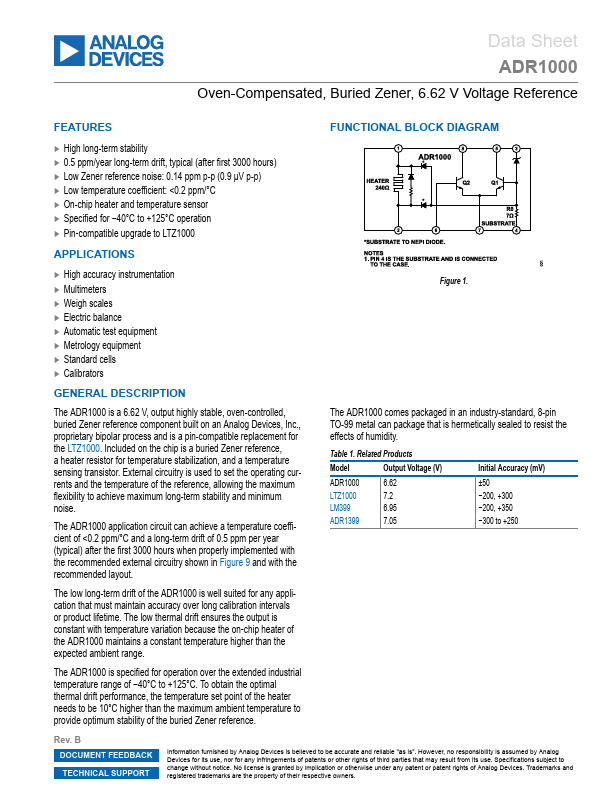
FUNCTIONAL BLOCK DIAGRAM
- High long-term stability
- 0.5 ppm/year long-term drift, typical (after first 3000 hours)
- Low Zener reference noise: 0.14 ppm p-p (0.9 µV p-p)
- Low temperature coefficient: <0.2 ppm/°C
- On-chip heater and temperature sensor
- Specified for
- 40°C to +125°C operation
- Pin‐patible upgrade to LTZ1000
APPLICATIONS
- High accuracy instrumentation
- Multimeters
- Weigh scales
- Electric balance
- Automatic test equipment
- Metrology equipment
- Standard cells
- Calibrators
Figure 1.
GENERAL DESCRIPTION
The ADR1000 is a 6.62 V, output highly stable, oven-controlled, buried Zener reference ponent built on an Analog Devices, Inc., proprietary bipolar process and is a pin-patible replacement for the LTZ1000. Included on the chip is a buried Zener reference, a heater resistor for temperature stabilization, and a temperature sensing transistor. External circuitry is used to set the operating currents and the temperature of the reference, allowing the maximum flexibility to achieve maximum long-term stability and minimum noise. The ADR1000 application circuit can achieve a temperature coefficient of <0.2 ppm/°C and a long-term drift of 0.5 ppm per year (typical) after the first 3000 hours when properly implemented with the remended external circuitry shown in Figure 9 and with the remended layout. The low long-term drift of the ADR1000 is well suited for any application that must maintain accuracy over long calibration intervals or product lifetime. The low thermal drift ensures the output is constant with temperature variation because the on‑chip heater of the ADR1000 maintains a constant temperature higher than the expected ambient range. The ADR1000 is specified for operation over the extended industrial temperature range of
- 40°C to +125°C. To obtain the optimal thermal drift performance, the temperature set point of the heater needs to be 10°C higher than the maximum ambient temperature to provide optimum stability of the...