ADUM3201
ADUM3201 is Digital Isolators manufactured by Analog Devices.
- Part of the ADUM3200 comparator family.
- Part of the ADUM3200 comparator family.
FEATURES
Enhanced system-level ESD performance per IEC 61000-4-x Narrow body, 8-lead SOIC, Pb-free package Low power operation 5 V operation 1.6 m A per channel maximum @ 0 Mbps to 2 Mbps 3.7 m A per channel maximum @ 10 Mbps 7.5 m A per channel maximum @ 25 Mbps 3 V operation 1.4 m A per channel maximum @ 0 Mbps to 2 Mbps 2.4 m A per channel maximum @ 10 Mbps 4.6 m A per channel maximum @ 25 Mbps Bidirectional munication 3 V/5 V level translation High temperature operation: 105°C High data rate: dc to 25 Mbps (NRZ) Precise timing characteristics 3 ns maximum pulse-width distortion 3 ns maximum channel-to-channel matching High mon-mode transient immunity: >25 k V/μs Safety and regulatory approvals UL recognition: 2500 V rms for 1 minute per UL 1577 CSA ponent Acceptance Notice #5A VDE Certificate of Conformity DIN EN 60747-5-2 (VDE 0884 Part 2): 2003-01 DIN EN 60950 (VDE 0805): 2001-12; DIN EN 60950: 2000 VIORM = 560 V peak
GENERAL DESCRIPTION
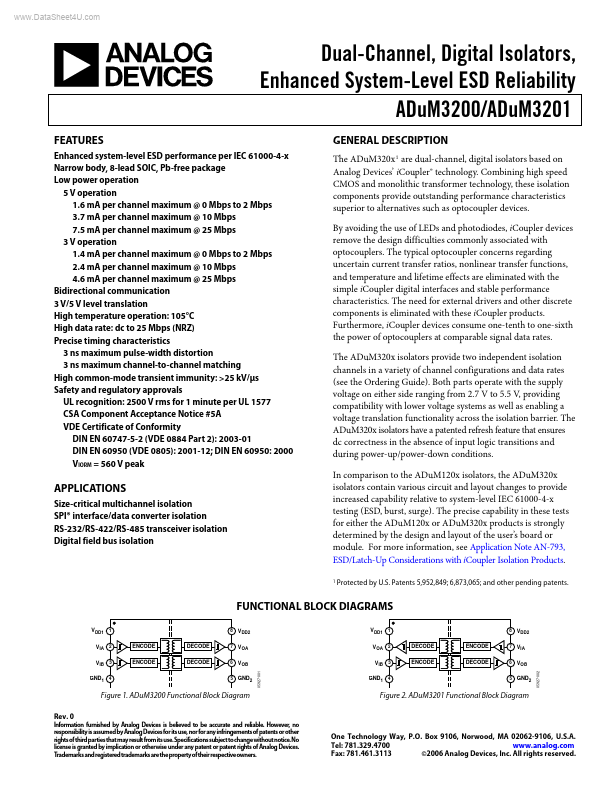
The ADu M320x 1 are dual-channel, digital isolators based on Analog Devices’ i Coupler® technology. bining high speed CMOS and monolithic transformer technology, these isolation ponents provide outstanding performance characteristics superior to alternatives such as optocoupler devices. By avoiding the use of LEDs and photodiodes, i Coupler devices remove the design difficulties monly associated with optocouplers. The typical optocoupler concerns regarding uncertain current transfer ratios, nonlinear transfer functions, and temperature and lifetime effects are eliminated with the simple i Coupler digital interfaces and stable performance characteristics. The need for external drivers and other discrete ponents is eliminated with these i Coupler products. Furthermore, i Coupler devices consume one-tenth to one-sixth the power of optocouplers at parable signal data rates. The ADu M320x isolators provide two independent isolation channels in a variety of channel configurations and data rates (see the Ordering Guide). Both parts operate with...