• Part: IOT7210
  • Description: Low Power CMOS IEEE 488 Controller Device
  • Manufacturer: Unknown Manufacturer
  • Size: 154.78 KB
Download IOT7210 Datasheet PDF
Unknown Manufacturer
IOT7210
IOT7210 is Low Power CMOS IEEE 488 Controller Device manufactured by Unknown Manufacturer.
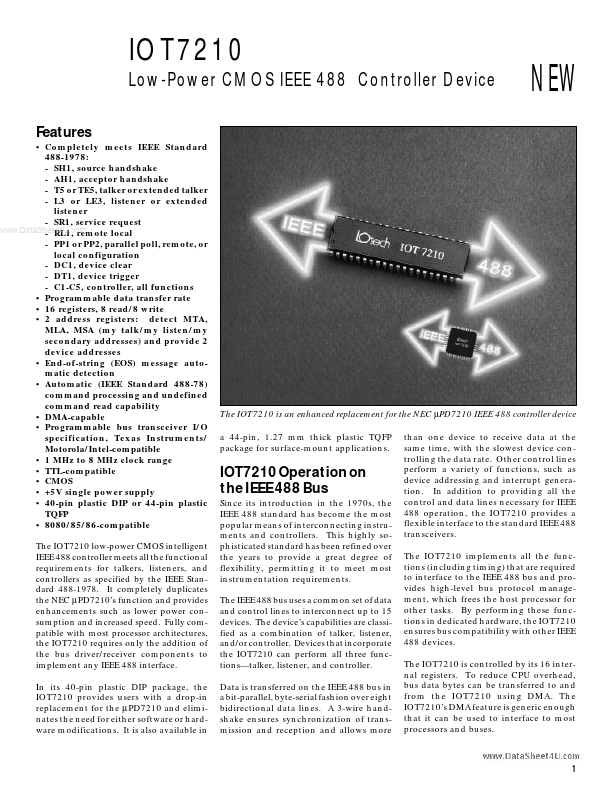
Features - pletely meets IEEE Standard 488-1978: - SH1, source handshake - AH1, acceptor handshake - T5 or TE5, talker or extended talker - L3 or LE3, listener or extended listener - SR1, service request .. - RL1, remote local - PP1 or PP2, parallel poll, remote, or local configuration - DC1, device clear - DT1, device trigger - C1-C5, controller, all functions - Programmable data transfer rate - 16 registers, 8 read/8 write - 2 address registers: detect MTA, MLA, MSA (my talk/my listen/my secondary addresses) and provide 2 device addresses - End-of-string (EOS) message automatic detection - Automatic (IEEE Standard 488-78) mand processing and undefined mand read capability - DMA-capable - Programmable bus transceiver I/O specification, Texas Instruments/ Motorola/Intel-patible - 1 MHz to 8 MHz clock range - TTL-patible - CMOS - +5V single power supply - 40-pin plastic DIP or 44-pin plastic TQFP - 8080/85/86-patible The IOT7210 low-power CMOS intelligent IEEE 488 controller meets all the functional requirements for talkers, listeners, and controllers as specified by the IEEE Standard 488-1978. It pletely duplicates the NEC µ PD7210’s function and provides enhancements such as lower power consumption and increased speed. Fully patible with most processor architectures, the IOT7210 requires only the addition of the bus driver/receiver ponents to implement any IEEE 488 interface. In its 40-pin plastic DIP package, the IOT7210 provides users with a drop-in replacement for the µ PD7210 and eliminates the need for either software or hardware modifications. It is also available in The IOT7210 is an enhanced replacement for the NEC µPD7210 IEEE 488 controller device a 44-pin, 1.27 mm thick plastic TQFP package for surface-mount applications. than one device to receive data at the same time, with the slowest device controlling the data rate. Other control lines perform a variety of functions, such as device addressing and interrupt generation. In addition to providing...