FLD3F12JL
FLD3F12JL is MQW-DFB Return Path Laser manufactured by Fujitsu Semiconductor Limited.
FEATURES
- Multiple Quantum Well (MQW) DFB Laser Loading
- Wide operating temperature without TEC Characteristics
- Built-in optical isolator
- Coaxial module with vertical flange
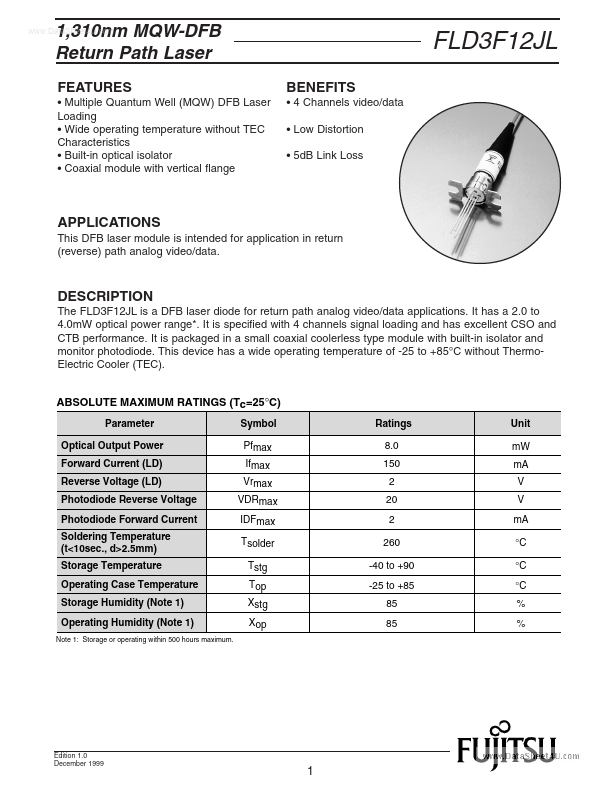
BENEFITS
- 4 Channels video/data
- Low Distortion
- 5d B Link Loss
APPLICATIONS
This DFB laser module is intended for application in return (reverse) path analog video/data.
DESCRIPTION
The FLD3F12JL is a DFB laser diode for return path analog video/data applications. It has a 2.0 to 4.0m W optical power range- . It is specified with 4 channels signal loading and has excellent CSO and CTB performance. It is packaged in a small coaxial coolerless type module with built-in isolator and monitor photodiode. This device has a wide operating temperature of -25 to +85°C without Thermo Electric Cooler (TEC). ABSOLUTE MAXIMUM RATINGS (Tc=25°C)
Parameter Optical Output Power Forward Current (LD) Reverse Voltage (LD) Photodiode Reverse Voltage Photodiode Forward Current Soldering Temperature (t<10sec., d>2.5mm) Storage Temperature Operating Case Temperature Storage Humidity (Note 1) Operating Humidity (Note 1)
Note 1: Storage or operating within 500 hours maximum.
Symbol Pfmax Ifmax Vrmax VDRmax IDFmax Tsolder Tstg Top Xstg Xop
Ratings 8.0 150 2 20 2 260 -40 to +90 -25 to +85 85 85
Unit m W m A V V m A °C °C °C % %
Edition 1.0 December 1999
..
1,310nm MQW-DFB Return Path Laser
OPTICAL AND ELECTRICAL CHARACTERISTICS (Tc=-25 to +85°C, unless otherwise specified)
Parameter Fiber Output Power Threshold Current Forward Voltage Slope Efficiency Slope Efficiency at Tc=25°C Slope Efficiency Ratio Peak Wavelength Side Mode Suppression Ratio posite Second Order posite Triple Beat Relative Intensity Noise Frequency Flatness Monitor Current Monitor Dark Current Tracking Error
Note (1): Note (2): Note (3): Note (4):
Symbol Pf Ith VF S S25 RTS λp SSR CSO CTB RIN Im ID TE
Test Conditions CW, IF=Iop CW CW, IF=Iop CW, IF=Iop CW, IF=Iop, Tc=25°C S(Tc)/S25 CW, IF=Iop CW, IF=Iop Note (1)...