

Datasheet4U Logo Datasheet4U.com

MSA1104 - Cascadable Silicon Bipolar MMIC Amplifier

Download the MSA1104 datasheet PDF. This datasheet also covers the MSA-1104_Hewlett variant, as both devices belong to the same cascadable silicon bipolar mmic amplifier family and are provided as variant models within a single manufacturer datasheet.

Description

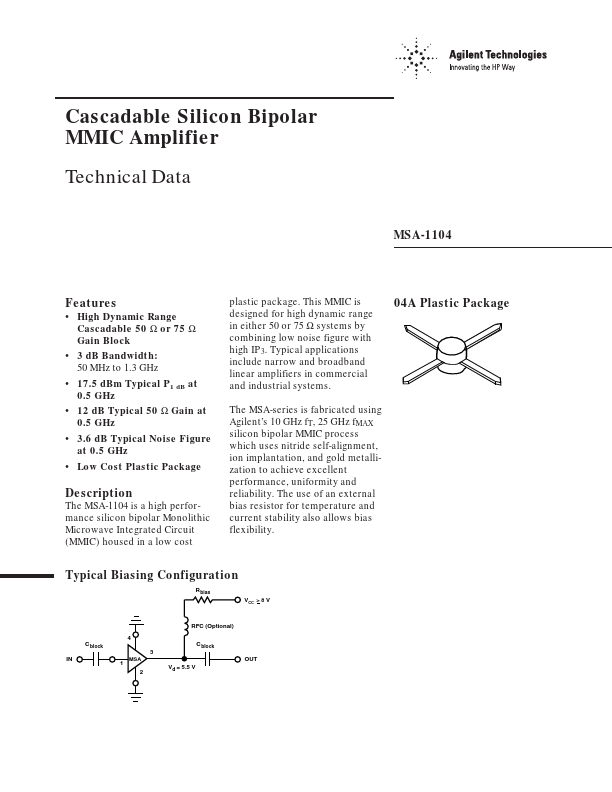
The MSA-1104 is a high performance silicon bipolar Monolithic Microwave Integrated Circuit (MMIC) housed in a low cost Typical Biasing Configuration R bias VCC > 8 V RFC (Optional) 4 C block 3 IN 1 MSA C block OUT Vd = 5.5 V 2 2 MSA-1104 Absolute Maximum Ratings Parameter Device Current Power

Features

  • High Dynamic Range Cascadable 50 Ω or 75 Ω Gain Block.
  • 3 dB Bandwidth: 50 MHz to 1.3 GHz.
  • 17.5 dBm Typical P1 dB at 0.5 GHz.
  • 12 dB Typical 50 Ω Gain at 0.5 GHz.
  • 3.6 dB Typical Noise Figure at 0.5 GHz.
  • Low Cost Plastic Package plastic package. This MMIC is designed for high dynamic range in either 50 or 75 Ω systems by combining low noise figure with high IP3. Typical.

📥 Download Datasheet

Note: The manufacturer provides a single datasheet file (MSA-1104_Hewlett-Packard.pdf) that lists specifications for multiple related part numbers.

Datasheet Details

Part number MSA1104
Manufacturer Hewlett-Packard
File Size 44.00 KB
Description Cascadable Silicon Bipolar MMIC Amplifier
Datasheet download datasheet MSA1104 Datasheet

Full PDF Text Transcription

Click to expand full text
Cascadable Silicon Bipolar MMIC Amplifier Technical Data MSA-1104 Features • High Dynamic Range Cascadable 50 Ω or 75 Ω Gain Block • 3 dB Bandwidth: 50 MHz to 1.3 GHz • 17.5 dBm Typical P1 dB at 0.5 GHz • 12 dB Typical 50 Ω Gain at 0.5 GHz • 3.6 dB Typical Noise Figure at 0.5 GHz • Low Cost Plastic Package plastic package. This MMIC is designed for high dynamic range in either 50 or 75 Ω systems by combining low noise figure with high IP3. Typical applications include narrow and broadband linear amplifiers in commercial and industrial systems. The MSA-series is fabricated using Agilent’s 10 GHz fT, 25 GHz fMAX silicon bipolar MMIC process which uses nitride self-alignment, ion implantation, and gold metallization to achieve excellent performance, uniformity and reliability.
Published: |