

ML620Q416A Description
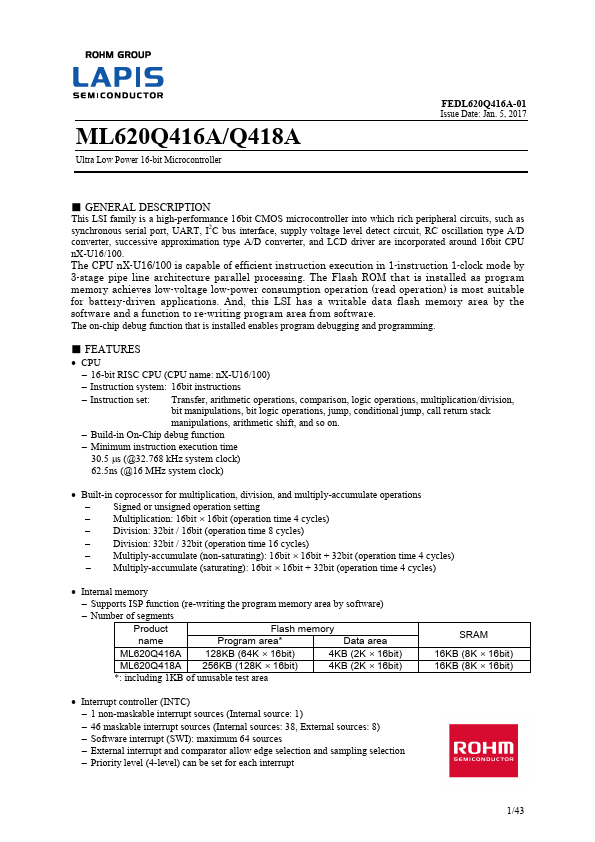
This LSI family is a high-performance 16bit CMOS microcontroller into which rich peripheral circuits, such as synchronous serial port, UART, I2C bus interface, supply voltage level detect circuit, RC oscillation type A/D converter, successive approximation type A/D converter, and LCD driver are incorporated around 16bit CPU nX-U16/100. The CPU nX-U16/100 is capable of efficient instruction execution in 1-instruction...
ML620Q416A Key Features
- 16-bit RISC CPU (CPU name: nX-U16/100)
- Instruction system: 16bit instructions
- Instruction set: Transfer, arithmetic operations, parison, logic operations, multiplication/division, bit manipulations,
- Build-in On-Chip debug function
- Minimum instruction execution time 30.5 µs (@32.768 kHz system clock) 62.5ns (@16 MHz system clock)
- Built-in coprocessor for multiplication, division, and multiply-accumulate operations
- Signed or unsigned operation setting
- Multiplication: 16bit × 16bit (operation time 4 cycles)
- Division: 32bit / 16bit (operation time 8 cycles)
- Division: 32bit / 32bit (operation time 16 cycles)