

Datasheet4U Logo Datasheet4U.com

ML610Q794G - Sensor Control Hub 8-bit Microcontroller

General Description

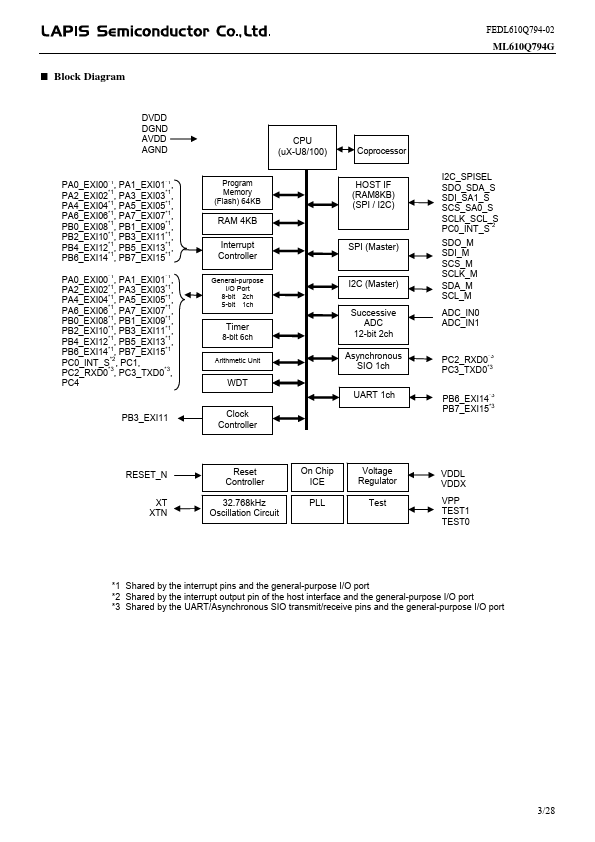
The ML610Q794G is a high-performance 8-bit low power microcontroller optimized for sensor hub applications that integrates LAPIS Semiconductor’s original high-performance 8-bit CPU core, with a 16-bit multiplier/divider co-processor, 64 KByte flash memory, 4 KByte RAM, multiple interfaces for vario

Key Features

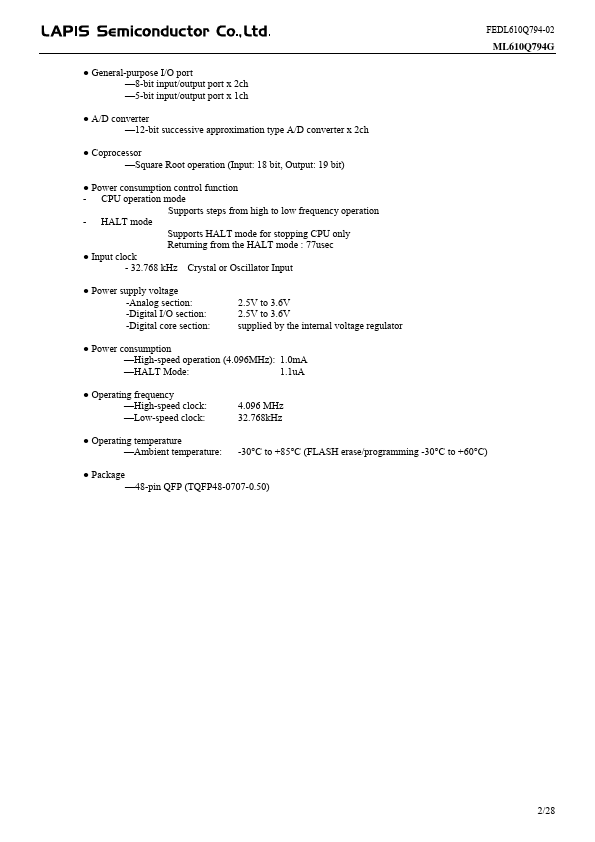
  • CPU.
  • 8-bit RISC CPU (CPU name: uX-U8/100).
  • 16-bit length instruction system.
  • Minimum instruction execution time 30.5 us (32.768 kHz system clock) 0.25 us (4.096 MHz system clock).
  • Built-in co-processor for multiplication, division, and multiply-accumulate operations Multiplication (Input: 16-bit x 16-bit, Output: 32-bit) Division (Input: 32-bit/16-bit, Output: 32-bit) Multiply-accumulate (Input: 16-bit x 16-bit + 32-bit, Output: 32-bit).
  • Internal mem.

📥 Download Datasheet

Datasheet Details

Part number ML610Q794G
Manufacturer LAPIS Semiconductor
File Size 498.21 KB
Description Sensor Control Hub 8-bit Microcontroller
Datasheet download datasheet ML610Q794G Datasheet

Full PDF Text Transcription for ML610Q794G (Reference)

Note: Below is a high-fidelity text extraction (approx. 800 characters) for ML610Q794G. For precise diagrams, tables, and layout, please refer to the original PDF.

ML610Q794G Sensor Control Hub 8-bit Microcontroller FEDL610Q794-02 Issue Date: Jan. 29, 2015 ■ General Description The ML610Q794G is a high-performance 8-bit low power mi...

View more extracted text
al Description The ML610Q794G is a high-performance 8-bit low power microcontroller optimized for sensor hub applications that integrates LAPIS Semiconductor’s original high-performance 8-bit CPU core, with a 16-bit multiplier/divider co-processor, 64 KByte flash memory, 4 KByte RAM, multiple interfaces for various sensors and host interfaces with 8KByte logging RAM in 48pin TQFP package. The ML610Q794G is an ideal sensor hub microcontroller for personal healthcare equipments, wearable devices, and sensor nodes that all require power efficient control and data collection from multiple sensors.