MXD7210NL
MXD7210NL is Low Noise -10 g Dual Axis Accelerometer manufactured by MEMSIC.
- Part of the MXD7210GL comparator family.
- Part of the MXD7210GL comparator family.
FEATURES
Low cost Resolution better than 1milli-g at 1Hz Dual axis accelerometer fabricated on a monolithic CMOS IC On chip mixed signal processing No moving parts; No loose particle issues >50,000 g shock survival rating 5mm X 5mm X 2mm LCC package 2.7V to 5.25V single supply continuous operation pensated for Sensitivity over temperature Ultra low initial Zero-g Offset No adjustment needed outside
APPLICATIONS puter Peripherals Information Appliances Alarms and Motion Detectors Disk Drives Vehicle Security GENERAL DESCRIPTION
The MXD7210GL/HL/ML/NL is a low cost, dual axis accelerometer fabricated on a standard, submicron CMOS process. It is a plete sensing system with on-chip mixed signal processing. The MXD7210GL/HL/ML/NL measures acceleration with a full-scale range of ±10 g and a sensitivity of 4%/g @5V. It can measure both dynamic acceleration (e.g. vibration) and static acceleration (e.g. gravity). The MXD7210GL/HL/ML/NL design is based on heat convection and requires no solid proof mass. This eliminates stiction and particle problems associated with petitive devices and provides shock survival greater than 50,000 g, leading to significantly lower failure rate and lower loss due to handling during assembly and at customer field application.
Information furnished by MEMSIC is believed to be accurate and reliable. However, no responsibility is assumed by MEMSIC for its use, nor for any infringements of patents or other rights of third parties which may result from its use. No license is granted by implication or otherwise under any patent or patent rights of MEMSIC.
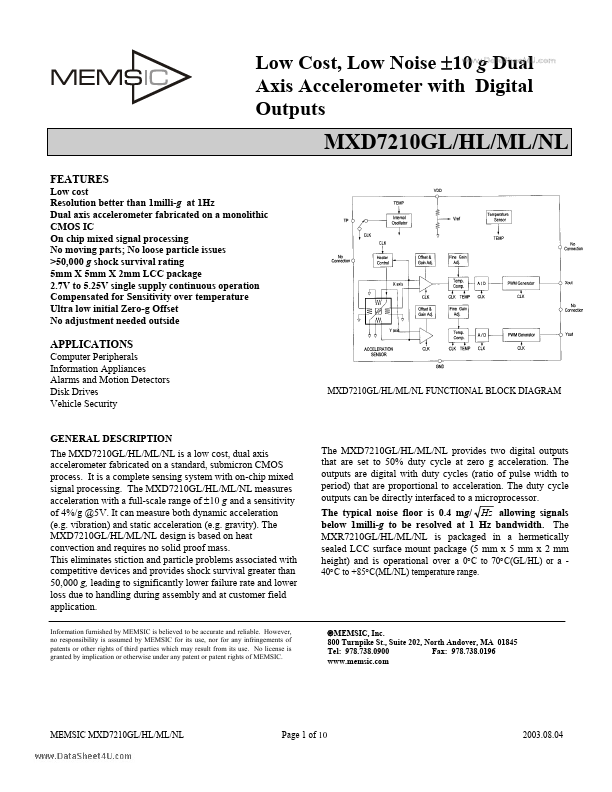
MXD7210GL/HL/ML/NL FUNCTIONAL BLOCK DIAGRAM
The MXD7210GL/HL/ML/NL provides two digital outputs that are set to 50% duty cycle at zero g acceleration. The outputs are digital with duty cycles (ratio of pulse width to period) that are proportional to acceleration. The duty cycle outputs can be directly interfaced to a microprocessor. The typical noise floor is 0.4 mg/ Hz allowing signals below...