

Datasheet4U Logo Datasheet4U.com

MAX17049 - 1-Cell/2-Cell Fuel Gauge

Download the MAX17049 datasheet PDF. This datasheet also covers the MAX17048 variant, as both devices belong to the same 1-cell/2-cell fuel gauge family and are provided as variant models within a single manufacturer datasheet.

General Description

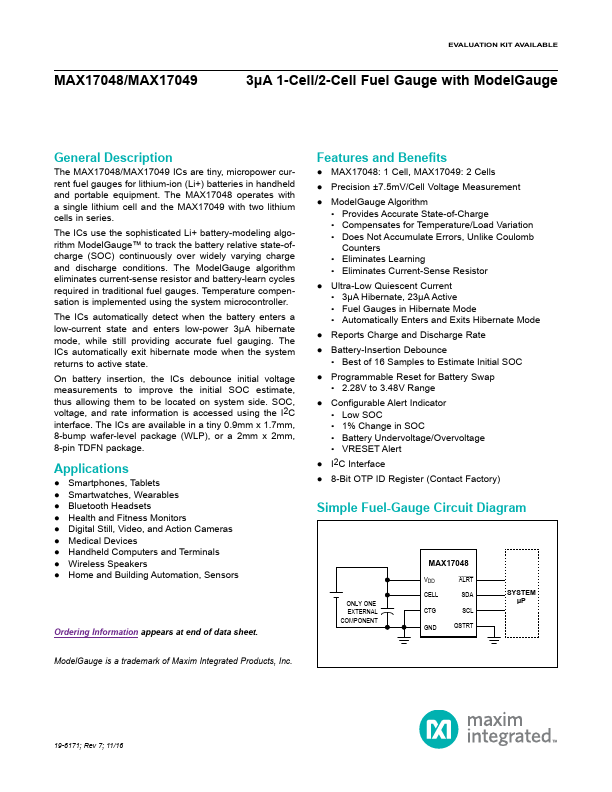
The MAX17048/MAX17049 ICs are tiny, micropower current fuel gauges for lithium-ion (Li+) batteries in handheld and portable equipment.

The MAX17048 operates with a single lithium cell and the MAX17049 with two lithium cells in series.

Key Features

  • S MAX17048: 1 Cell, MAX17049: 2 Cells S Precision ±7.5m­V/Cell Voltage Measurement S ModelGauge Algorithm.
  • Provides Accurate State-of-Charge.
  • Compensates for Temperature/Load Variation.
  • Does Not Accumulate Errors, Unlike Coulomb Counters.
  • Eliminates Learning.
  • Eliminates Current-Sense Resistor S Ultra-Low Quiescent Current.
  • 4µA Hibernate, 23µA Active.
  • Fuel Gauges in Hibernate Mode.
  • Automatically Enters and Exits Hibernate Mode S Report.

📥 Download Datasheet

Note: The manufacturer provides a single datasheet file (MAX17048-MaximIntegrated.pdf) that lists specifications for multiple related part numbers.

Full PDF Text Transcription (Reference)

The following content is an automatically extracted verbatim text from the original manufacturer datasheet and is provided for reference purposes only.

View original datasheet text
EVALUATION KIT AVAILABLE MAX17048 / MAX17049 Micropower 1-Cell/2-Cell Li+ ModelGauge ICs General Description The MAX17048/MAX17049 ICs are tiny, micropower current fuel gauges for lithium-ion (Li+) batteries in handheld and portable equipment. The MAX17048 operates with a single lithium cell and the MAX17049 with two lithium cells in series. The ICs use the sophisticated Li+ battery-modeling algorithm ModelGaugeK to track the battery relative state-of-charge (SOC) continuously over widely varying charge and discharge conditions. The ModelGauge algorithm eliminates current-sense resistor and battery-learn cycles required in traditional fuel gauges. Temperature compensation is implemented using the system microcontroller.