

Datasheet4U Logo Datasheet4U.com

MAX19790 - Analog Voltage Variable Attenuator

Description

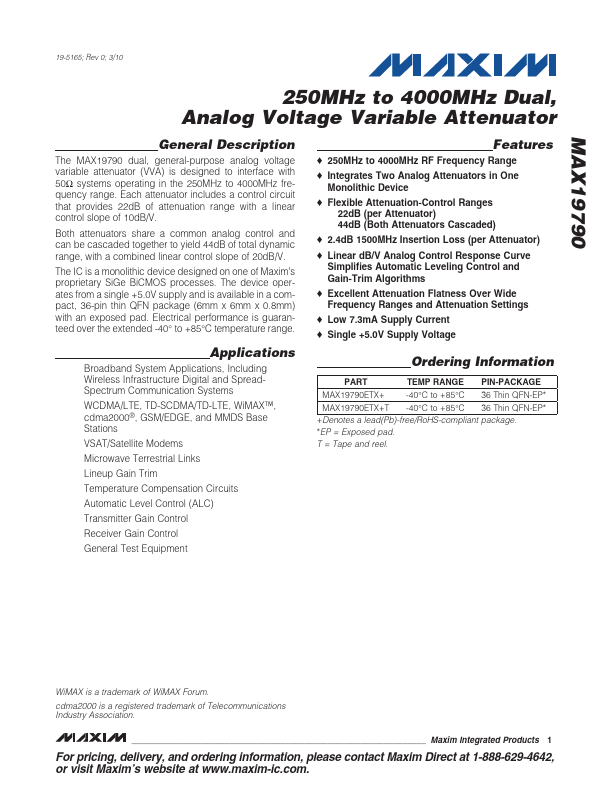
The MAX19790 dual, general-purpose analog voltage variable attenuator (VVA) is designed to interface with 50I systems operating in the 250MHz to 4000MHz frequency range.

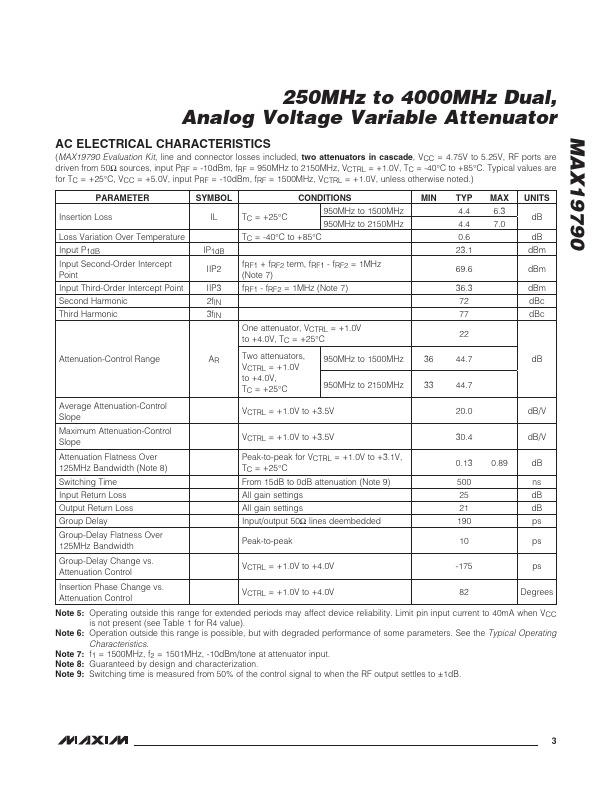
Each attenuator includes a control circuit that provides 22dB of attenuation range with a linear control slope of 10dB/V.

Features

  • S 250MHz to 4000MHz RF Frequency Range S Integrates Two Analog Attenuators in One Monolithic Device S Flexible Attenuation-Control Ranges 22dB (per Attenuator) 44dB (Both Attenuators Cascaded) S 2.4dB 1500MHz Insertion Loss (per Attenuator) S Linear dB/V Analog Control Response Curve Simplifies Automatic Leveling Control and Gain-Trim Algorithms S Excellent Attenuation Flatness Over Wide Frequency Ranges and Attenuation Settings S Low 7.3mA Supply Current S Single +5.0V Supply Voltage O.

📥 Download Datasheet

Full PDF Text Transcription (Reference)

The following content is an automatically extracted verbatim text from the original manufacturer datasheet and is provided for reference purposes only.

View original datasheet text
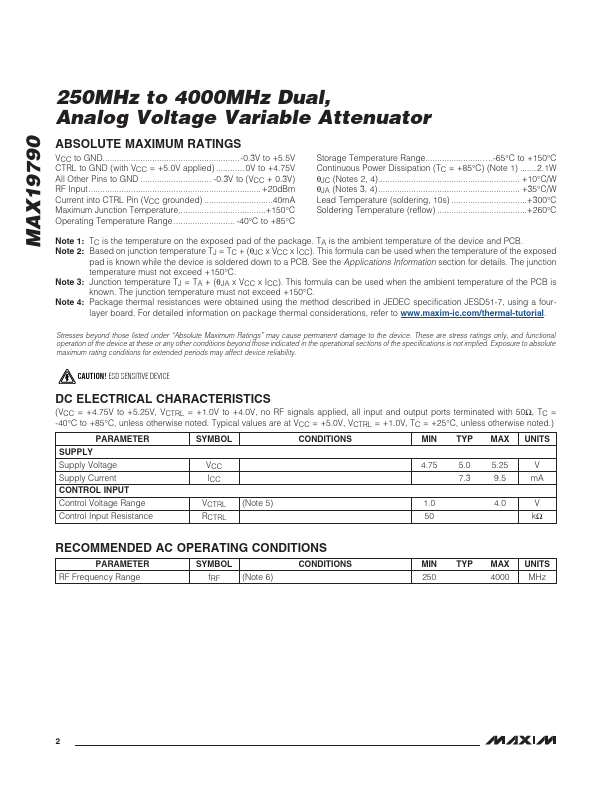
MAX19790 19-5165; Rev 0; 3/10 250MHz to 4000MHz Dual, Analog Voltage Variable Attenuator General Description The MAX19790 dual, general-purpose analog voltage variable attenuator (VVA) is designed to interface with 50I systems operating in the 250MHz to 4000MHz frequency range. Each attenuator includes a control circuit that provides 22dB of attenuation range with a linear control slope of 10dB/V. Both attenuators share a common analog control and can be cascaded together to yield 44dB of total dynamic range, with a combined linear control slope of 20dB/V. The IC is a monolithic device designed on one of Maxim’s proprietary SiGe BiCMOS processes. The device operates from a single +5.0V supply and is available in a compact, 36-pin thin QFN package (6mm x 6mm x 0.8mm) with an exposed pad.
Published: |