Datasheet4U Logo Datasheet4U.com

DS2712 - (DS2711 / DS2712) Loose Cell NiMH Chargers

Download the DS2712 datasheet PDF. This datasheet also covers the DS2711 variant, as both devices belong to the same (ds2711 / ds2712) loose cell nimh chargers family and are provided as variant models within a single manufacturer datasheet.

General Description

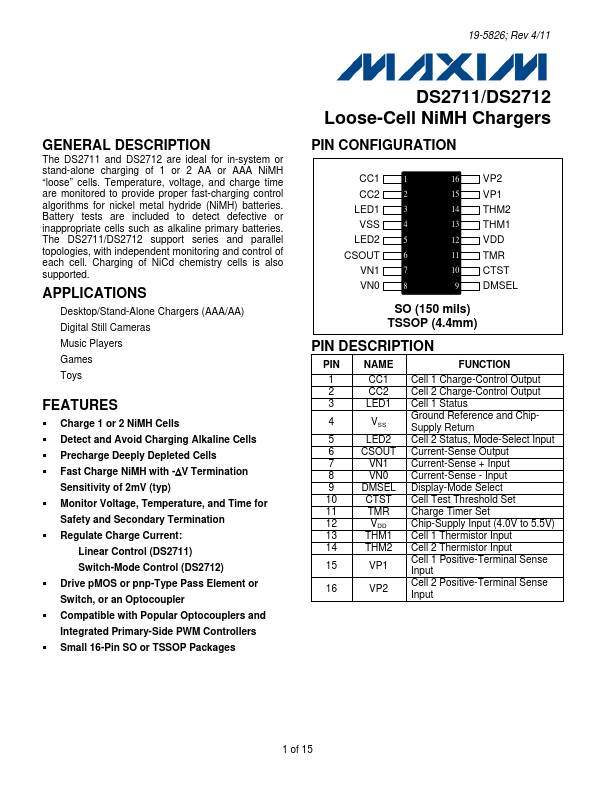
The DS2711 and DS2712 are ideal for in-system or stand-alone charging of 1 or 2 AA or AAA NiMH “loose” cells.

Temperature, voltage, and charge time are monitored to provide proper fast-charging control algorithms for nickel metal hydride (NiMH) batteries.

Key Features

  • Charge 1 or 2 NiMH Cells.
  • Detect and Avoid Charging Alkaline Cells.
  • Precharge Deeply Depleted Cells.
  • Fast Charge NiMH with -∆V Termination Sensitivity of 2mV (typ).
  • Monitor Voltage, Temperature, and Time for Safety and Secondary Termination.
  • Regulate Charge Current: Linear Control (DS2711) Switch-Mode Control (DS2712).
  • Drive pMOS or pnp-Type Pass Element or Switch, or an Optocoupler.
  • Compatible with Popular Optocouplers and Integrated Primary-Side PWM Con.

📥 Download Datasheet

Note: The manufacturer provides a single datasheet file (DS2711_MaximIntegratedProducts.pdf) that lists specifications for multiple related part numbers.

Full PDF Text Transcription for DS2712 (Reference)

Note: Below is a high-fidelity text extraction (approx. 800 characters) for DS2712. For precise diagrams, and layout, please refer to the original PDF.

19-5826; Rev 4/11 GENERAL DESCRIPTION The DS2711 and DS2712 are ideal for in-system or stand-alone charging of 1 or 2 AA or AAA NiMH “loose” cells. Temperature, voltage, ...

View more extracted text
harging of 1 or 2 AA or AAA NiMH “loose” cells. Temperature, voltage, and charge time are monitored to provide proper fast-charging control algorithms for nickel metal hydride (NiMH) batteries. Battery tests are included to detect defective or inappropriate cells such as alkaline primary batteries. The DS2711/DS2712 support series and parallel topologies, with independent monitoring and control of each cell. Charging of NiCd chemistry cells is also supported.