

Datasheet4U Logo Datasheet4U.com

DM74ALS138 - 3 to 8 Line Decoder/Demultiplexer

Description

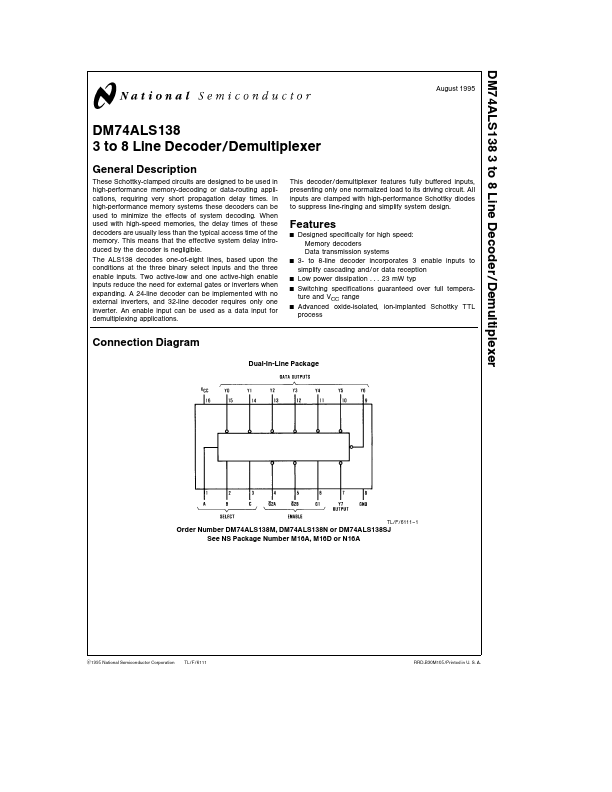
These Schottky-clamped circuits are designed to be used in high-performance memory-decoding or data-routing applications requiring very short propagation delay times In high-performance memory systems these decoders can be used to minimize the effects of system decoding When used with high-speed mem

Features

  • fully buffered inputs presenting only one normalized load to its driving circuit All inputs are clamped with high-performance Schottky diodes to suppress line-ringing and simplify system design Features Y Designed specifically for high speed Memory decoders Data transmission systems Y 3- to 8-line decoder incorporates 3 enable inputs to simplify cascading and or data reception Y Low power dissipation 23 mW typ Y Switching specifications guaranteed over full tempera- ture and VCC range Y Advanced.

📥 Download Datasheet

Datasheet preview – DM74ALS138

Datasheet Details

Part number DM74ALS138
Manufacturer National Semiconductor
File Size 102.86 KB
Description 3 to 8 Line Decoder/Demultiplexer
Datasheet download datasheet DM74ALS138 Datasheet
Additional preview pages of the DM74ALS138 datasheet.
Other Datasheets by National Semiconductor

Full PDF Text Transcription

Click to expand full text
DM74ALS138 3 to 8 Line Decoder Demultiplexer August 1995 DM74ALS138 3 to 8 Line Decoder Demultiplexer General Description These Schottky-clamped circuits are designed to be used in high-performance memory-decoding or data-routing applications requiring very short propagation delay times In high-performance memory systems these decoders can be used to minimize the effects of system decoding When used with high-speed memories the delay times of these decoders are usually less than the typical access time of the memory This means that the effective system delay introduced by the decoder is negligible The ALS138 decodes one-of-eight lines based upon the conditions at the three binary select inputs and the three enable inputs Two active-low and one active-high enable inputs reduce the need f
Published: |