Datasheet4U Logo Datasheet4U.com

DM74S163 - Synchronous 4-Bit Binary Counters

This page provides the datasheet information for the DM74S163, a member of the DM74S161 Synchronous 4-Bit Binary Counters family.

Description

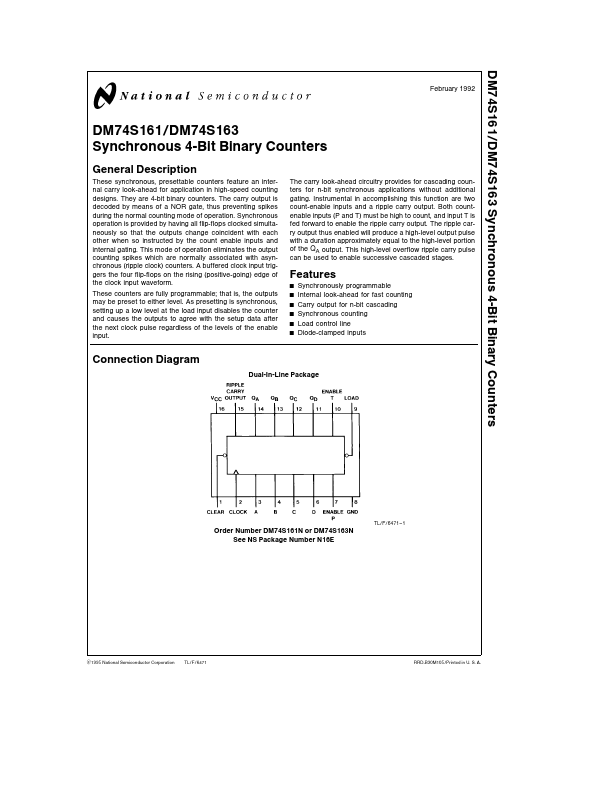
These synchronous presettable counters feature an internal carry look-ahead for application in high-speed counting designs They are 4-bit binary counters The carry output is decoded by means of a NOR gate thus preventing spikes during the normal counting mode of operation Synchronous operation is pr

Features

  • Y Synchronously programmable Y Internal look-ahead for fast counting Y Carry output for n-bit cascading Y Synchronous counting Y Load control line Y Diode-clamped inputs Connection Diagram Dual-In-Line Package Order Number DM74S161N or DM74S163N See NS Package Number N16E TL F 6471.
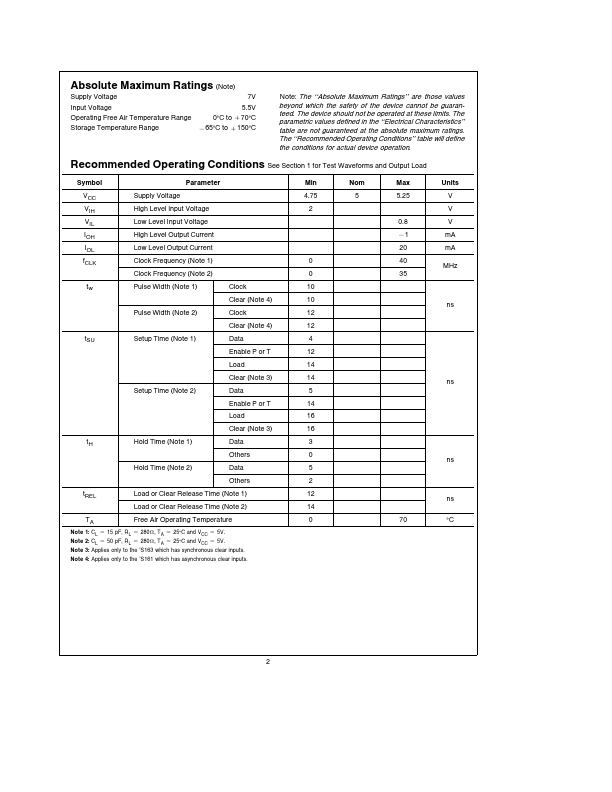
  • 1 C1995 National Semiconductor Corporation TL F 6471 RRD-B30M105 Printed in U S A Absolute Maximum Ratings (Note) Supply Voltage 7V Input Voltage 5 5V Operating Free Air Temperature Range 0 C to.

📥 Download Datasheet

Datasheet preview – DM74S163

Datasheet Details

Part number DM74S163
Manufacturer National Semiconductor
File Size 132.00 KB
Description Synchronous 4-Bit Binary Counters
Datasheet download datasheet DM74S163 Datasheet
Additional preview pages of the DM74S163 datasheet.
Other Datasheets by National Semiconductor

Full PDF Text Transcription

Click to expand full text
DM74S161 DM74S163 Synchronous 4-Bit Binary Counters February 1992 DM74S161 DM74S163 Synchronous 4-Bit Binary Counters General Description These synchronous presettable counters feature an internal carry look-ahead for application in high-speed counting designs They are 4-bit binary counters The carry output is decoded by means of a NOR gate thus preventing spikes during the normal counting mode of operation Synchronous operation is provided by having all flip-flops clocked simultaneously so that the outputs change coincident with each other when so instructed by the count enable inputs and internal gating This mode of operation eliminates the output counting spikes which are normally associated with asynchronous (ripple clock) counters A buffered clock input triggers the four flip-flops
Published: |