Datasheet4U Logo Datasheet4U.com

NCP13616 - Low Power Offline Constant Current PWM Controller

This page provides the datasheet information for the NCP13616, a member of the NCP1361 Low Power Offline Constant Current PWM Controller family.

Description

Pin out NCP1366 Pin out NCP1361 Name 1 6 Vs/ZCD 2 5 FB 3 4 CS 4 3 DRV 5 2 GND 6 1 VCC 7 NC 8 HV Function Connected to the auxiliary winding; this pin senses the voltage output for the primary regulation and detects the core reset event for the Quasi

Features

  • ±10% Current Regulation.
  • 560 V Startup Current Source.
  • No Frequency Clamp, 80 or 110 kHz Maximum Switching Frequency Options.
  • Quasi.
  • Resonant Operation with Valley Switching Operation.
  • Fixed Peak Current & Deep Frequency Foldback @ Light Load Operation.
  • External Constant Voltage Feedback Adjustment.
  • Cycle by Cycle Peak Current Limit.
  • Built.
  • In Soft.
  • Start.
  • Over & Under Output Voltage Protection.

📥 Download Datasheet

Datasheet preview – NCP13616

Datasheet Details

Part number NCP13616
Manufacturer ON Semiconductor
File Size 917.50 KB
Description Low Power Offline Constant Current PWM Controller
Datasheet download datasheet NCP13616 Datasheet
Additional preview pages of the NCP13616 datasheet.
Other Datasheets by ON Semiconductor

Full PDF Text Transcription

Click to expand full text
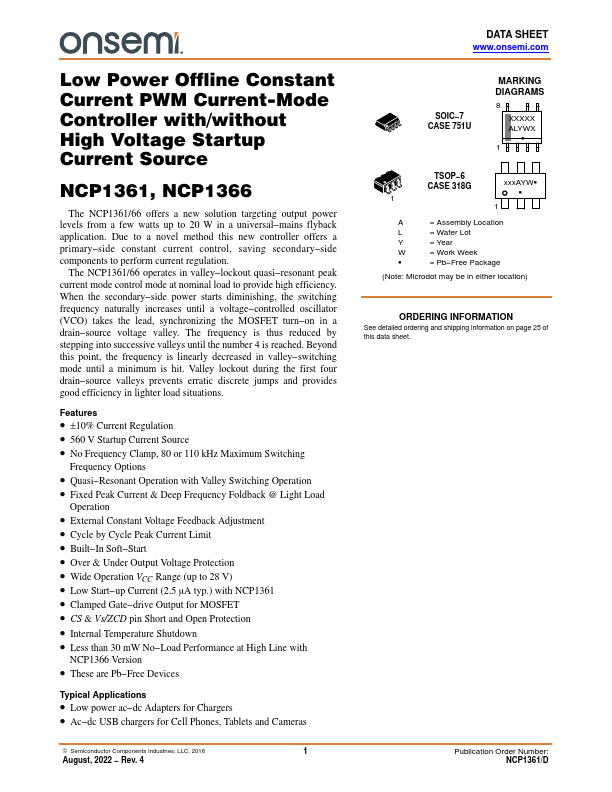
Low Power Offline Constant Current PWM Current-Mode Controller with/without High Voltage Startup Current Source NCP1361, NCP1366 The NCP1361/66 offers a new solution targeting output power levels from a few watts up to 20 W in a universal−mains flyback application. Due to a novel method this new controller offers a primary−side constant current control, saving secondary−side components to perform current regulation. The NCP1361/66 operates in valley−lockout quasi−resonant peak current mode control mode at nominal load to provide high efficiency. When the secondary−side power starts diminishing, the switching frequency naturally increases until a voltage−controlled oscillator (VCO) takes the lead, synchronizing the MOSFET turn−on in a drain−source voltage valley.
Published: |